Europe
Russia to cut Estonia fuel transit amid statue row
(Reuters)
Updated: 2007-05-03 10:21
 |
Large Medium Small |
Russia halted deliveries of oil products to Estonia on Wednesday in a move that coincided with protests in Moscow over the Baltic state's relocation of a Soviet war memorial.
The cut-off was likely to revive Western fears the Kremlin is using its energy might as a political weapon against ex-Soviet neighbours.
Russia's state rail monopoly said it planned to carry out maintenance on the rail link to Estonia, disrupting supplies.
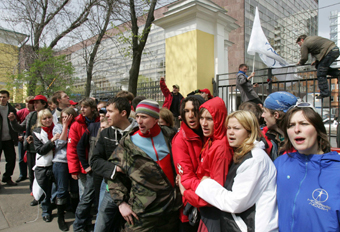 Protesters supporting the Kremlin shout anti-Estonian slogans outside a press centre where Estonia's ambassador to Moscow Marina Kaljurand is holding a news conference in Moscow May 2, 2007. Russian youths protesting against Estonia's removal of a World War Two Red Army monument broke into a hall where Kaljurand was to hold a news conference on Wednesday.[Reuters]  |
They said Russian rail monopoly RzHD told them they must use their own rail wagons, not RzHD's, but it has not been possible with such short notice to find alternative wagons.
Moscow and Tallinn have been trading barbs since Estonia last week moved a bronze statue of a Red Army soldier -- revered in Russia as a symbol of its huge sacrifices in World War Two -- from its spot in the centre of the capital.
Estonia said the statue was a public order menace and focus for Estonian and Russian nationalists. Many Estonians see the statue as a reminder of 50 years of Soviet rule.
Germany, holder of the European Union's rotating presidency, said it was deeply concerned about the row and by rolling protests by pro-Kremlin youth groups outside Estonia's embassy in Moscow that diplomats there say amounts to a blockade.
The European Commission said it would send a delegation to raise the matter with Moscow. Russia's foreign ministry said Estonia was to blame for the protests.
The protests, in their sixth day, escalated sharply on Wednesday when a group of demonstrators stormed a news conference shortly before Estonia's ambassador arrived. The ambassador's bodyguards sprayed gas to disperse the protesters.
Estonian Prime Minister Andrus Ansip spoke to German Chancellor Angela Merkel about the protests in Moscow, his office said.
"This is a well-coordinated and flagrant intervention with the internal affairs of Estonia," Ansip told parliament.
"We have turned to the European Union and we ask them to take immediate action. Attacking one member state means an attack against the entire European Union," he added.
DARK CLOUD
The dispute is likely to cast a cloud over an EU-Russia summit to be held in Russia on May 18.
Russia sends a quarter of its oil products exports -- including fuel oil, diesel and gasoline -- by rail to Estonia, from where it is re-exported to northern Europe.
A spokeswoman for Russian railways denied there was any political motive to the disruption, but traders said it was linked to the row with Estonia.
"It was bound to happen, given the recent political dispute," said a trader with a Russian major.
Russia has a track record of turning off the energy taps during disputes with neighbours, though in each case it has cited technical or commercial reasons.
U.S. Vice President Dick Cheney has accused the Kremlin of using energy as a tool of "intimidation and blackmail."
In one of several cases, in 2005 Russia cut off gas supplies to Ukraine, led by pro-Western President Viktor Yushchenko. The cut-off briefly disrupted deliveries to European customers.
Earlier on Wednesday, about 25 demonstrators shouting "shame on Estonia!" and "fascism will not be allowed!" burst into the hall where Estonian ambassador Marina Kaljurand was expected to speak to reporters.
At Estonia's embassy, another group of protesters mobbed the Swedish ambassador's car and ripped off the flag as he tried to drive off after visiting his Estonian counterpart, Swedish diplomats said.
Sweden's foreign ministry said it would be issuing Moscow with a "strong protest" over the incident.
A spokesman for Estonia's embassy said the protests had forced it to close its consulate and it was advising diplomats not to visit from Estonia.
Russia's foreign ministry said it would meet its commitments to safeguard the embassy. But chief spokesman Mikhail Kamynin said Russia was not to blame for the protests.
"Passions have been brought to the boil and we believe the blame for that rests entirely with the Estonian side," he said.
(Additional reporting by Patrick Lannin in Stockholm, Jackie Cowhig in London and Olesya Dmitracova, Dmitry Solovyov and Anton Doroshev in Moscow)
| 分享按钮 |