Middle East
Pressure seen rising for Olmert to quit
(AP)
Updated: 2007-04-30 10:31
 |
Large Medium Small |
JERUSALEM - Israelis Prime Minister Ehud Olmert will face fierce criticism when a government commission releases its first findings Monday on last year's inconclusive war in Lebanon, officials said, raising pressure on the Israeli leader to step down.
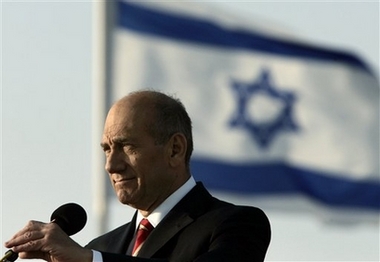 Israeli Prime Minister Ehud Olmert delivers a speech during a ceremony marking the anniversary of Theodor Herzl's birth in 1860, the founder of modern Zionism, at Mount Herzl cemetery in Jerusalem, Sunday, April 29, 2007. [AP]  |
Officials close to the investigation, confirming Israeli TV reports, said the report would be tough on both Olmert and Defense Minister Amir Peretz.
Among the findings are that both men made hasty and ill-judged decisions at the outset of the war, and these errors were compounded by their lack of experience and unfamiliarity with defense issues, the officials said.
Olmert reluctantly appointed the commission of inquiry in September under intense pressure from a public dissatisfied with the outcome of the 34-day war, which began when Hezbollah guerrillas captured two Israeli soldiers and killed three others in a July 12 cross-border raid.
Speaking to reporters on Sunday, Vice Premier Shimon Peres pledged that the report's findings would be taken seriously. "We shall correct everything that calls for correction," he said.
The interim report will analyze the first six days of the fighting, when the war's objectives were formulated, and the six years between Israel's May 2000 pullout from southern Lebanon and the outbreak of the conflict. The full report on the entire war is to be released in the summer.
The war failed to achieve two aims Olmert set - crushing the Islamic militant Hezbollah and returning the two captured soldiers. The military also has been criticized for failing to stop Hezbollah from bombarding northern Israel with almost 4,000 rockets, and soldiers returning from battle complained of a lack of supplies, poor preparation and conflicting orders.
Although the commission, headed by a retired judge, Eliyahu Winograd, does not have the power to dismiss officials, a disparaging report could spark mass protests and force Olmert and the equally unpopular Peretz to resign. Widespread criticism already led the wartime military chief, Lt. Gen. Dan Halutz, to step down in January, and demonstrations against Olmert were expected this week.
Neither Olmert nor Peretz have military backgrounds, and the fighting erupted less than two months after they took office. The report will not call for any resignations, the officials said, speaking on condition of anonymity because it has not been made public.
It will say that Halutz did not provide political leaders with a sufficient range of military options, played down the rocket threat and silenced dissenting opinions within the army command, Israeli media said.
Olmert's office declined comment until the report's official publication, but aides said the prime minister had no intention of quitting.
Following the initial leaks, Olmert faced a fresh chorus of resignation calls Sunday, both from the opposition and members of Peretz' Labor party, which is in the governing coalition. Two opposition lawmakers said they planned to submit bills to dissolve parliament and force early elections.
While Olmert remains deeply unpopular - his government has been plagued by a series of sex and corruption scandals - he may be able to survive since his coalition partners might prefer to keep the unpopular prime minister in power rather than face a disgruntled electorate.
Former Prime Minister Benjamin Netanyahu, leader of the hard-line Likud Party, would sweep to victory if new elections are held, according to polls in Israeli newspapers.
In the meantime, the war's heavy toll still reverberates. Between 1,035 and 1,191 Lebanese civilians and combatants were killed, as were 119 Israeli soldiers and 39 civilians.
The confrontation began with almost universal Israeli support, but that splintered as troops came back with reports that fighters were ill-trained and ill-equipped, hampered by confused orders and lacking basics like bullets and water.
Halutz, a former air force commander, was criticized for relying too heavily on air attacks that caused heavy Lebanese casualties and damage without smashing Hezbollah. The military was also faulted for sending ground troops into a major battle just hours before a UN-brokered truce was signed - an operation that cost the lives of more than 30 soldiers with questionable results.
Finally, the campaign's inconclusive outcome caused Israelis to rethink the wisdom of launching an all-out offensive to try to retrieve two soldiers.
Olmert gave seven hours of testimony in February before the commission in a closed-door hearing widely perceived as his last chance to stave off censure.
Last month, Olmert acknowledged his lack of popularity, but declared he would not step aside. "Though we are in the midst of the hunting season, I am sorry to disappoint my detractors - I am here to lead," he said.
Because the report will dwell heavily on the years preceding the war, Arye Carmon, head of the Israel Democracy Institute, said he didn't expect it to precipitate a major political upheaval.
"What we faced in July was decided several years ago," Carmon said. "I don't believe that (the report) will bring about the end of his tenure."
| 分享按钮 |