Iran-EU nuclear talks progressing
(AP)Updated: 2007-04-26 17:04
ANKARA, Turkey - Iran's top nuclear negotiator said Thursday that talks with a senior EU official had brought them closer to "a united view" of how to break a deadlock over Tehran's defiance of a UN Security Council demand to freeze uranium enrichment.
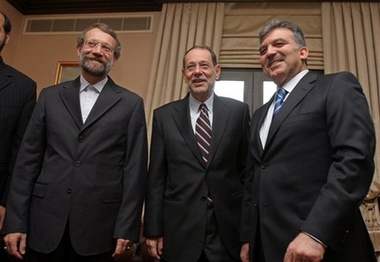 Iran's top nuclear envoy Ali Larijani, left, Javier Solana, the European Union's senior Foreign Policy official, center, and Turkey's Foreign Minister Abdullah Gul look toward cameras before a meeting in Gul's residence in Ankara, Turkey, Thursday, April 26, 2007. [AP]  |
"In some areas we are approaching a united view," Larijani told reporters after a breakfast meeting with Solana and Turkish Foreign Minister Abdullah Gul. "We are aiming to reach out for a common paradigm."
Solana spoke of a "good meeting," adding: "We cannot make miracles, but we tried to move ... the (nuclear) dossier forward.
"The fact that we are together again is itself a very important development," he said, alluding to the last time the two men met - in September talks that collapsed over the enrichment issue.
Neither revealed details of their talks. But a government official based in a European capital said the two touched on possible new discussions of what constituted a suspension of enrichment and related activities.
A new definition of an enrichment freeze acceptable to both sides was "the key issue," said the official, who demanded anonymity in exchange for discussing the confidential information with The Associated Press.
There also was mention of a "double time out" - a simultaneous freeze of such activities in exchange for a commitment not to impose new UN sanctions, said the official, who was briefed on the outcome of the meeting.
The "double time out" concept is supported by International Atomic Energy Agency chief Mohamed ElBaradei and is part of a confidential document shared on Wednesday with the AP.
The one-page document, based on a Swiss initiative, proposes that during such a double-moratorium "Iran will not develop any further its enrichment activities," and the six powers "will not table any additional UN resolutions and sanctions."
Diplomats said that the document is opposed by the United States, Britain and France but that parts of it could nonetheless serve as the basis of a later agreement that could lead to formal negotiations.
Solana was meeting with Larijani on behalf of the United
States, Russia, China, Britain, France and Germany - the countries at the
forefront of international efforts to pressure Iran to make nuclear concessions.
| 1 | 2 |  |
|
||
|
||
|
|