Bush administration awash in scandals
(AP)Updated: 2007-04-23 08:57
WASHINGTON - Campaigning in 2000, Texas Gov. George W. Bush would repeatedly raise his right hand as if taking an oath and vow to "restore honor and integrity" to the White House. He pledged to usher in a new era of bipartisanship.
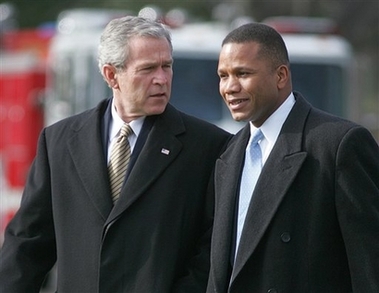 US President Bush departs the White House in this Feb. 2, 2005 file photo, with his domestic advisor Claude Allen, right. [AP]  |
Now, with fewer than two years left of his second term, the Bush administration is embroiled in multiple scandals and ethics investigations. The war in Iraq still rages. Bush's approval ratings are hovering in the mid-30s. And Democratic-Republican relations have seldom been more rancorous.
In the highest-profile current case, even some key Republicans are questioning the truthfulness and judgment of Attorney General Alberto Gonzales in the firing of eight US attorneys. The panel is investigating whether the prosecutors were dumped to make way for more politically obedient successors.
Gonzales is fighting to hold onto his job. So far, two top aides have resigned, one indicating she would invoke her Fifth Amendment right against self-incrimination if questioned by Congress. E-mails and other evidence released by the Justice Department suggest Bush political adviser Karl Rove played a part in the firings.
Congress is also investigating whether Rove and other Bush political advisers improperly used Republican e-mail accounts to discuss the firings and other official business. The White House concedes the possibility but says much of the e-mail was lost or deleted.
"I don't believe that," asserted Judiciary Committee Chairman Patrick Leahy, D-Vt.. , chairman of the Senate Judiciary Committee. White House spokeswoman Dana Perino acknowledged that "we screwed up."
The furor over Gonzales and Rove's e-mail practices follow disclosures of shoddy medical treatment of war-injured veterans, FBI abuses of civil liberties, and the conviction of a top White House aide of lying to a grand jury.
What ever happened to restoring honor and dignity?
"From the very beginning, this administration emphasized loyalty over competence. And at some point, that catches up with you," said Paul Light, a professor of public policy at New York University. He said the increase in scandals and investigations also reflects the "natural decay" that happens late in a second presidential term as many experienced people have already left and those remaining start focusing on their financial futures.
Some recent incidents:
- World Bank President Paul Wolfowitz, one of the architects of the Iraq war as deputy defense secretary, acknowledged he erred in helping a female friend he is dating to get transferred to a high-paying job at the State Department while remaining on the World Bank payroll. The revelations fueled calls from the bank's staff association for him to resign.
- Matteo Fontana, a Department of Education official who oversaw the student loan industry, was put on leave after disclosure that he owned at least $100,000 worth of stock in a student loan company.
- Lurita Doan, head of the General Services Administration, attended a luncheon at the agency earlier this year with other top GSA political appointees at which Scott Jennings, a top Rove aide, gave a PowerPoint demonstration on how to help Republican candidates in 2008. A congressional committee is investigating whether the remarks violated a federal law that restricts executive-branch employees from using their positions for political purposes.
- Julie MacDonald, who oversees the Fish and Wildlife Service but has no academic background in biology, overrode recommendations of agency scientists about how to protect endangered species and improperly leaked internal information to private groups, the Interior Department's inspector general said.
Increasing coziness between federal officials and the industries they oversee "is not endemic to any particular administration in Washington," said Fred Wertheimer, president of Democracy 21, which seeks to reduce the role of money in politics. "This has been an ongoing problem for some time now."
Potential conflicts "come into heavier play in the second term of two-term administrations because people who have been there for some time start leaving," said Wertheimer.
Both the House and the Senate, responding to voter frustration with corruption and special interest influence in Washington, have approved ethics and lobbying measures. But they apply only to members of Congress, restricting their gifts and free travel, and not to the executive branch.
Republicans like to emphasize that scandals, some large, most small, happen under Democratic presidents too. But Bush's critics say the number of current ethics allegations is unusually high. And they say evidence is strong of close links between the Bush administration and certain industries such as energy and defense.
For instance, Philip Cooney, a former oil-industry lobbyist who became chief of staff for the White House Council on Environmental Quality, acknowledged to a House committee last month that he edited three government reports to eliminate or downplay links between greenhouse gases and global warming - and defended the changes. He left the government in 2005 to work for Exxon Mobil Corp.
Former Air Force procurement officer Darleen Druyun served nine months in prison in 2005 for violating conflict-of-interest rules after agreeing to lease Boeing refueling tankers for $23 billion, despite Pentagon studies showing the tankers were unnecessary. After making the deal, she quit the government to join Boeing.
Scooter Libby, former chief of staff to Vice President Dick Cheney, became the first high-level White House official to be indicted while in office in more than 100 years.
He was convicted of perjury and obstruction of justice in a grand jury's investigation of the outing of CIA operative Valierie Plame. The trial also implicated Rove and Cheney in a campaign to discredit her husband, retired diplomat and Iraq war critic Joe Wilson.
Ties between Bush administration officials and convicted lobbyist Jack Abramoff also taken its toll in the executive branch, as it has in Congress.
J. Steven Griles, a former oil and gas lobbyist who became deputy interior secretary, last month became the highest-ranking administration official convicted in the Abramoff influence-peddling scandal, pleading guilty to obstructing justice by lying to a Senate committee about his relationship with Abramoff. Abramoff repeatedly sought Griles' intervention at Interior on behalf of Indian tribal clients.
Former White House aide, David H. Safavian, was convicted last year of lying to government investigators about his ties to Abramoff and faces an 180-month prison sentence. Roger Stillwell, a former Interior Department official, pleaded guilty to a misdemeanor charge for not reporting tickets he received from Abramoff.
Not all the administration officials who have left under a cloud have been accused of white-collar misconduct.
Claude Allen, who was Bush's domestic policy adviser, pleaded guilty to theft in making phony returns at discount department stores. He was sentenced last summer to two years of supervised probation and fined $500.
|
||
|
||
|
|