Iran urged to open nuke program to UN
(AP)Updated: 2007-03-06 19:24
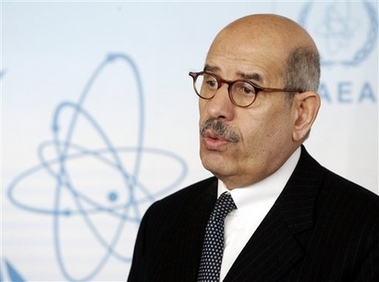 IAEA's Director General Mohamed ElBaradei speaks at a press briefing during the International Atomic Energy Agency's (IAEA) 35-nation board of governors meeting, on Monday, March 5, 2007, at Vienna's International Center. [AP]  |

On Monday, ElBaradei said his agency cannot be sure that Iran's nuclear activities are not a cover for a weapons program, adding that uncertainty will persist until Tehran decides to cooperate with his experts.
ElBaradei, whose agency has spent more than four years probing Tehran's nuclear activities, said the IAEA is "unable to provide the required assurance about the peaceful nature of Iran's nuclear program."
Unless Tehran takes "the long overdue decision" to cooperate with the IAEA, it "will have no option but to reserve its judgment about Iran's nuclear program," he said.
ElBaradei said that Tehran appeared to have at least temporarily paused in expanding its uranium-enrichment program at the heart of its standoff with the UN Security Council.
Any such pause could be an attempt to ease Iran's conflict with the Security Council, which is considering harsher sanctions on the Islamic Republic.
"I do not believe that the number of centrifuges has increased, nor do I believe that (new) nuclear material has been introduced to the centrifuges at Natanz," he told reporters, referring to the site housing Tehran's enrichment program and the machines used for enrichment.
But underlining that any pause was informal and temporary, ElBaradei, in separate comments, repeated the main finding of his recent report on Iran, saying that "Iran has not suspended its enrichment-related activities" as demanded by the Security Council.
A senior Iranian official dashed hopes that any short-term pause could translate into a freeze on its enrichment activities. Ali Ashgar Soltanieh, Iran's chief IAEA delegate, said his country would "never give up its inalienable right" to enrich uranium.
Iran has enriched small quantities of uranium to the low level suitable for nuclear fuel generation. The U.S. and its allies fear that Iran could build nuclear weapons with larger amounts of more highly enriched uranium.
Hard-line President Mahmoud Ahmadinejad had been expected to announce last month that Iran had started installing 3,000 uranium-enriching centrifuges at a facility in the desert outside the central city of Natanz, where it has about 500 centrifuges above and below ground. But the announcement never materialized, an apparent step back that ElBaradei appeared to confirm Monday.
Up for review as early as Tuesday at the Vienna meeting of the IAEA's 35 board nations will be a Feb. 22 report from ElBaradei finding that Tehran has set up hundreds of centrifuges as part of its continuing enrichment efforts.
The board was expected to approve last month's decision by ElBaradei to suspend nearly half the technical aid his agency provides to Iran. Only North Korea and Saddam Hussein's Iraq have faced such punishment in the past.
The European Union said it backed the suspensions, saying it "supports the (IAEA) ... views" on the 23 projects that could be suspended - 18 contained in the most recent recommendations and five frozen earlier.
The board also will be reviewing North Korea's apparent willingness to ultimately dismantle its nuclear arms-making capabilities.
| ||
|
||
|
||
|
|