Asia-Pacific
Pakistan denies hosting bin Laden
(AP)
Updated: 2007-03-01 08:34
 |
Large Medium Small |
ISLAMABAD, Pakistan - Pakistan on Wednesday rejected a claim by the US intelligence chief that Osama bin Laden and his deputy were hiding in northwestern Pakistan, and that al-Qaida was setting up camps near the Afghan border.
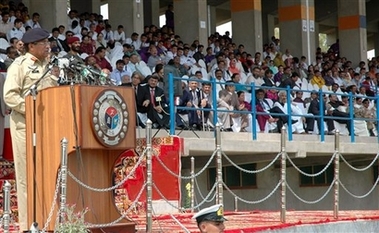 Pakistan's President Gen. Pervez Musharraf, left, address a reception at a military college in Patoro near Hyderabad, Pakistan, Wednesday, Feb 28, 2007. [AP]  |
Musharraf spoke a day after new US intelligence chief Mike McConnell told a Senate Armed Services Committee hearing that al-Qaida is trying to set up training camps and other operations in Pakistan tribal areas near Afghanistan.
"It's something we're very worried about and very concerned about," McConnell said. US intelligence officials believe that bin Laden and his deputy, Ayman al-Zawahri, were trying to establish an al-Qaida base in the region, he said. McConnell noted the camps are in an area that has never been governed by any state or outside power.
"We deny it," Interior Minister Aftab Khan Sherpao told The Associated Press, referring to McConnell's remarks.
Sherpao told The Associated Press there were no al-Qaida training camps in his country and US officials had not provided any intelligence suggesting there were.
On a visit to Pakistan on Monday, Vice President Dick Cheney met with Musharraf to seek his aid in foiling an anticipated spring offensive by the Taliban and al-Qaida against coalition forces in Afghanistan.
Cheney was accompanied by Deputy CIA Director Stephen Kappes, suggesting that the US officials were prepared to buttress their allegations about al-Qaida operations with intelligence data.
Musharraf told Cheney that Pakistan was already doing all it could to fight the militants, his office said.
Musharraf vowed Wednesday to take "stiff action" to expel foreign militants from Pakistan's mountainous border regions, the Associated Press of Pakistan news agency reported.
"People have come there from outside. They are living in our mountains and spreading terrorism not just in Pakistan but in the entire world," APquoted Musharraf as saying at a public meeting in the southern Sindh province.
"These people are putting Pakistan in danger. These people should leave and go, otherwise we will have to deal with them and we are dealing with them," AP quoted him as saying.
US officials are concerned about a peace deal Pakistan signed with tribal leaders of the North Waziristan region in September. In that agreement, the tribes promised to respect the authority of the Pakistani government and curtail cross-border attacks by militants.
In return, Musharraf returned some of the tribes' weapons, released some prisoners and withdrew from posts inside North Waziristan.
At Tuesday's hearing, Lt. Gen. Michael Maples, head of the Defense Intelligence Agency, said the tribes have not abided by most terms of the agreement. McConnell added US intelligence believes al-Qaida's training and related capabilities increased as a result of the deal.
Musharraf's office confirmed that during the meeting, Cheney expressed concern that al-Qaida was "regrouping" in the tribal areas and that the vice president "called for concerted efforts in countering the threat."
Sherpao insisted Pakistan was "fighting the scourge of terrorism in the best interest of Pakistan."
Musharraf is a key ally of the United States in its fight against Islamic militants.
| 分享按钮 |