Mortars hit Somalia's airport
(AP)Updated: 2007-01-25 09:34
MOGADISHU, Somalia - Gunmen launched mortars Wednesday on Mogadishu International Airport, killing at least two people a day after powerful troops from neighboring Ethiopia began withdrawing from this chaotic nation.
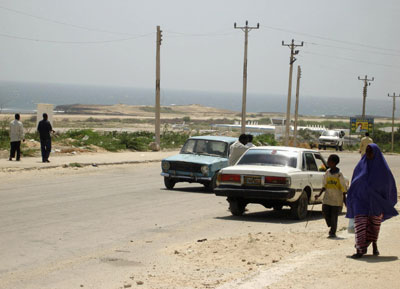 People walk near the international airport in Somalia's capital Mogadishu January 24, 2007. [Reuters]  |
The officials, who spoke on condition of anonymity because the strike was carried out in secret by an Air Force AC-130 gunship earlier this week, provided few details and were uncertain whether the intended target was killed.
Wednesday's mortar attack in Mogadishu came as Ethiopian troops began pulling out after helping the Somali government drive a radical Islamic militia out of the capital and much of southern Somalia. Ethiopia's intervention last month prompted a military advance that was a stunning turnaround for Somalia's 2-year-old government.
Without Ethiopia's tanks and fighter jets, the government could barely assert control outside one town and couldn't enter the capital, which was ruled by the Council of Islamic Courts. The US accused the group of having ties to al-Qaida.
Abdilkabir Salad, who was at the gate of the airport when the mortars fell, said he saw two corpses. Another witness, Abdi Mohamed, said he saw three wounded men who were hit with shrapnel.
"Two mortars landed inside the airport and the other outside," Mohamed said. "There were three planes on the runway when the attack happened." The runway was not damaged.
The US Ambassador to Kenya, Michael Ranneberger, who also represents US interests in Somalia, met Wednesday with a top leader of the ousted Islamic movement in Nairobi, Kenya, according to an embassy official who refused to elaborate.
Sheik Sharif Sheik Ahmed, considered by American officials a moderate who could contribute to rebuilding Somalia, turned himself in to authorities in Kenya because he apparently was afraid for his life. He is not believed to be wanted by the authorities.
Ethiopian Prime Minister Meles Zenawi, when asked whether he believed Ahmed should be part of the peace process, said: "As far as I know, Sheik Sharif doesn't represent anybody." He also said "quite a few" Somali fighters captured by his forces were being held in Ethiopia. He declined to elaborate.
In Washington, Defense Department spokesman Bryan Whitman declined to confirm any new strike but said that in general the United States is "going to go after al-Qaida in the global war on terrorism wherever it takes us."
He said the nature of some military operations, especially those by special operations commando forces, requires that they be kept secret in order to preserve an advantage in future missions.
Lt. Cmdr. Marc Boyd, a spokesman at US Special Operations Command, declined to comment.
Earlier this month, Ethiopian and US forces were pursuing three top al-Qaida suspects but failed to capture or kill them in an AC-130 strike in the southern part of Somalia. A main target that time was Fazul Abdullah Mohammed, one of three senior al-Qaida members blamed for the 1998 bombings of the US embassies in Kenya and Tanzania.
The US Navy also has had forces in waters off the Somali coast, where they have monitored maritime traffic, boarded suspicious ships and interrogated crews in an attempt to catch anyone escaping the Somalia military operations.
Navy officials said Wednesday that no aircraft from the USS Dwight D. Eisenhower, stationed off the Somali coast, were involved in the latest strike.
The withdrawal of Ethiopia, which says it cannot afford to stay in Somalia, raises a sense of urgency for the arrival of a proposed African peacekeeping force. The African Union has approved a plan to send about 8,000 peacekeepers for a six-month mission that would eventually be taken over by the UN.
Malawi and Uganda have said they want to contribute troops, but no firm plans are in place.
|
||
|
||
|
|