Rice cool to temporary Palestinian state
(AP)Updated: 2007-01-17 15:30
KUWAIT CITY - Secretary of State Condoleezza Rice sounded cool to the notion of a placeholder Palestinian state in temporary borders, an idea that Israelis had said might energize the dormant peace process.
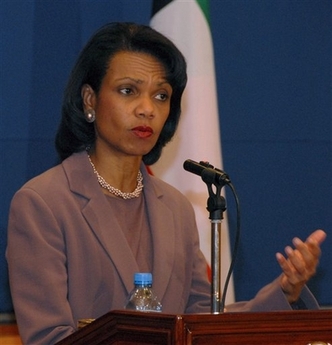 US Secretary of State Dr. Condoleezza Rice answers questions from journalists during a joint press conference with Kuwait's Foreign Minister Sheikh Mohammed Al Sabah, unseen, at Bayan Palace, Bayan, Kuwait City on Tuesday, Jan. 16, 2007. [AP]  |
Rice, speaking to reporters Tuesday, did not rule out the idea, though. Palestinians reject it as a nonstarter, arguing that temporary lines would be too hard to redraw and Israel might end up with large swaths of the West Bank that Palestinians claim is theirs.
"My own view, and I frankly have been telling people this, (is) that if we get to that point it seems to me that it may be more difficult to negotiate a provisional state than just to go to the end game" of final borders, Rice said. "We're not there yet, and we'll see."
Rice planned to brief German and British leaders this week about the possible next steps toward peace. She was dining with German Foreign Minister Frank-Walter Steinmeier in Berlin on Wednesday and with British Foreign Secretary Margaret Beckett in London on Thursday.
The Bush administration supports an eventual independent Palestinian state alongside Israel. That is the goal of a 2003 US-backed international peace plan that has gotten little traction.
Rice spent a long weekend in Israel and the West Bank assessing the possible next steps toward peace, and on Monday said she will attend a three-way confidence-building session with Israeli and Palestinian leaders.
Israeli Prime Minister Ehud Olmert and Palestinian President Mahmoud Abbas prefer an informal session to a larger regional or international peace conference, Rice said, referring to an idea advanced in Europe and some Arab capitals.
"That really raises expectations that something is imminent," Rice told reporters traveling with her on a Mideast tour.
In the same session, Rice channeled her background as a college professor for what sounded like her answer Tuesday to criticism that the Bush administration won't talk to its adversaries.
Iraq Study Group authors and piqued senators are among those who accuse the Bush administration of being shortsighted in rejecting talks with Iran and Syria that might help reduce the sectarian violence in Iraq.
"There's a tendency to think about diplomacy as something that is done untethered to the conditions underlying it or the balance underlying it," Rice said partway through a lengthy academic disquisition on the difficulty of recognizing big historical change.
"That's not the way that it works," Rice said. "You aren't going to be successful as a diplomat if you don't understand the strategic context in which you are actually negotiating. It is not dealmaking."
Bush's plan, announced last week, rejects the idea of outreach to Iran and Syria and would add US forces in Iraq.
|
||
|
||
|
|