MOSCOW - The swift move to penalize North Korea for its nuclear test could
clear the way for punishing Iran over its disputed nuclear program, Secretary of
State Condoleezza Rice said Saturday. "It really does help to create a
momentum," Rice said after leaving four days of crisis talks in Asia in response
to the North's test.
|
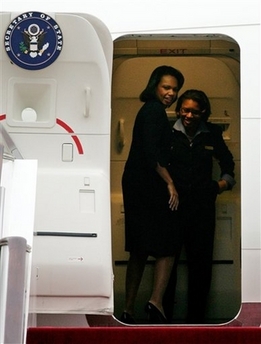
US Secretary of State Condoleezza Rice, left, looks back
after boarding her plane at Beijing airport Saturday Oct 21, 2006. Rice
left Beijing after seeking help from Chinese leaders in pressuring North
Korea to return to six-party talks on its nuclear program.
[AP]
|
Yet Rice as headed into meetings with
Russian leaders on North Korea and Iran, the foreign minister insisted Moscow
will not allow the United Nations to impose punitive sanctions against Tehran.
"We won't be able to support and will oppose any attempts to use the Security
Council to punish Iran or use Iran's program in order to promote the ideas of
regime change there," Sergey Lavrov told the Kuwaiti News Agency KUNA, according
to a posting on the Russian Foreign Ministry's Web site Saturday. Russia is a
permanent member of the Security Council and can veto its actions.
Rice's last stop before Russia was China, North Korea's traditional ally,
where she met with a Chinese government envoy just back from a hastily arranged
visit with North Korean leader Kim Jong Il. Rice said the envoy, State Councilor
Tang Jiaxuan, told her nothing that confirmed news reports about conciliatory
moves from the North.
South Korean media had reported that Kim said he was "sorry about the nuclear
test" and that the North had no plans for additional tests.
Rice said Tang did not tell her that Kim "either apologized for the test or
said that he would never test again," Rice said.
North Korea's Oct. 9 test was a main topic for Rice's meeting with Russian
President Vladimir Putin, but her underlying mission is to persuade Moscow to
approve U.N. penalties against Iran.
Lavrov, in the Kuwaiti interview, said Russia was ready to discuss ways to
pressure Iran into accepting broader international oversight of its nuclear
program. But, he said, "any measures of influence should encourage creating
conditions for talks."
The Security Council is expected to consider a draft sanctions resolution
next week. Iran claims its nascent program to produce nuclear fuel is intended
only to develop peaceful nuclear power. The United States and some allies claim
Iran is hiding plans to build a bomb.
Last weekend's unanimous vote by the Security Council to rebuke North Korea
followed only a few days of debate. The council has been considering Iran's case
since February.
"I don't think you'll have the kind of resolution on Iran that you have on
North Korea," Rice said. "After all this is a program that is much further
along; there was a nuclear test."
Rice expressed confidence the council would pass a resolution on Iran, saying
the council is very engaged in nuclear nonproliferation efforts.
"That helps to create an atmosphere in which no one is going to want to have
a successful resolution against North Korea and no action against Iran, which
also at a different level is a threat to the nonproliferation regime," Rice
said.
Russia did vote to punish North Korea despite reservations and only after the
U.S. agreed to water down the penalties. Russia, which along with China has
lucrative trade ties with Iran, has resisted US-led calls for punitive measures
against Tehran.
Russian analysts suggest that after the North Korean vote, Moscow may agree
to token measures against Tehran in return for assurances on its $800 million
contract to build Iran's first nuclear power station.
Russia has come under strong pressure from the United States to halt work on
the nuclear reactor in the southern city of Bushehr, which is due to start work
next September. Fuel from the plant potentially could be diverted and used to
produce bombs.
Moscow has refused to cancel the contract or an order worth $700 million to
supply 29 sophisticated Tor-M1 air defense missile systems to Iran.
Any UN measures against Iran are likely to be soft. Council diplomats
indicated the draft to be circulated by Britain and France will seek to ban the
import and export of material and equipment that could be used to produce
nuclear, chemical, and biological weapons.
The US has urged broad penalties, such as a total ban on missile and nuclear
technology sales. Russia and China back prohibitions of selected items as a
first step.
Six nations including the US offered Iran economic incentives and political
rewards in June if it agreed to consider a long-term halt to uranium enrichment
and commit to a freeze before talks to discuss details of the offer.
But Iranian President Mahmoud Ahmadinejad has repeatedly and defiantly said
his country would continue enrichment and is not intimidated by the possibility
of UN punishments.
On North Korea, the Russian foreign minister urged the US and the North to
settle issues such as US-imposed financial restrictions in order to clear the
way for international talks to resume on the North's nuclear program.
"This problem emerged separately from the six-nation talks. It should be
resolved independently from them as well," Lavrov said in the Kuwaiti interview.
He said both sides "should show flexibility."
