RAMALLAH, West Bank - Palestinian President Mahmoud Abbas said on Thursday he
would take key decisions over the Hamas-led government's fate in the latest move
to tackle a deadlock between Abbas's Fatah group and Hamas.
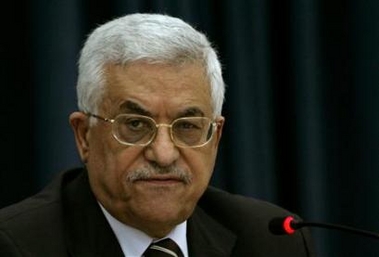
Palestinian President Mahmoud Abbas
at his headquarters in the West Bank city of Ramallah, October 17, 2006.
[Reuters] |
"We will take key decisions concerning setting up a government that is
committed to Arab and international law in order to lift the siege imposed on
our people and to ease their suffering," Abbas told Christian and Muslim
religious leaders in the West Bank city of Ramallah.
Abbas, who spoke during the evening Iftar meal when Muslims break their
fasting in the month of Ramadan, did not give a timeframe for any move.
Hamas took power in March, after which the United States and the European
Union imposed sanctions on its government, blocking direct aid and support on
which the administration depended.
The measures were imposed because Israel, the United States and the European
Union regard Hamas as a terrorist group. They say it must recognise Israel,
renounce violence and respect existing peace agreements before sanctions can be
lifted.
Abbas said this week he had to make a decision soon on the future of the
Hamas government and that he might seek approval for any move in a referendum.
Hamas's Interior Minister Saeed Seyam said in response the militant Islamist
movement would consider as a "coup" any referendum called by Abbas.
Abbas said on Thursday he would make decisions "in order to focus attention
on our fateful issues and ending Israeli occupation measures to reach peace that
guarantees the establishment of an independent state that lives next to Israel."
Abbas has hinted he would sack the government and has said talks on forming a
unity coalition with the Islamist movement were dead over its refusal to soften
its stance toward Israel.
The power struggle has dashed Palestinian hopes that a unity cabinet would
lead to a lifting of Western sanctions and sparked fighting this month between
gunmen from Hamas and Fatah in which at least 19 people were killed, sparking
fears of civil war.
Abbas, a moderate, has not explicitly said what his options were but his
aides have said he might call fresh elections, appoint an emergency government
or hold a referendum to let the Palestinian people decide what to do.
While the Palestinian basic law, which serves as a constitution, allows the
president to sack the government, it does not mention other alternatives such as
calling early polls.
