Asia-Pacific
N.Korea apparently preparing nuke test
(AP)
Updated: 2006-10-18 09:08
 |
Large Medium Small |
Japan's nuclear predicament after N.Korea test
Restraint is 'best way to ease tension'
SEOUL, South Korea - Satellite images indicate North Korea appears to be getting ready for a second nuclear test, officials said Tuesday, as the country held huge rallies and proclaimed that UN sanctions amount to a declaration of war.[Full coverage on nuclear crisis]
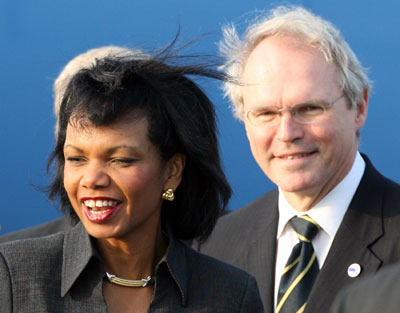 US Secretary of State Condoleeza Rice (L) and US Assistant Secretary of State Christopher Hill arrive at Tokyo's Haneda airport October 18, 2006. [Reuters] |
The UN has condemned the October 9 atomic blast, and US nuclear envoy Christopher Hill told reporters in Seoul on Tuesday that another nuclear explosion would be "a very belligerent answer" to the world.
As the White House acknowledged that the nation might try a second test, Secretary of State Condoleezza Rice launched a diplomatic drive to persuade Asian allies and Russia to intensify North Korea's isolation by enforcing sanctions that the UN Security Council unanimously approved on Saturday.
Shortly before Rice arrived Wednesday for meetings with Foreign Minister Taro Aso and other Japanese officials, Aso said Japan should openly discuss whether it wants to possess nuclear weapons.
He told a parliamentary committee the government has no plans to stray from its post-World War II policy of not allowing nuclear bombs on Japanese soil, "But I think it is important to discuss the issue."
Alexander Vershbow, the US ambassador to South Korea, said Wednesday in Seoul that Rice plans to ask the South to expand its role in a US-led international program to stop the spread of weapons of mass destruction.
Concern over a second test stems partly from new satellite imagery showing increased activity around at least two other North Korean sites, a senior US defense official said.
The activity, started a number of days ago, included ground preparation at one site and construction of some buildings and other structures, said the official, who spoke on condition of anonymity because it involved intelligence gathering. He said that although the purpose of the structures is unclear, officials are concerned because North Korea has left open the possibility of another test.
A senior South Korean official told foreign journalists that despite signs of a possible second test, it was unlikely to happen immediately.
"We have yet to confirm any imminent signs of a second nuclear test," the official said on condition of anonymity because of the sensitivity of the information.
In North Korea, the nation marked the 80th anniversary of the "Down-with-Imperialism Union" - political platform on which the ruling party was built. North Koreans held parades across the country along with an enormous gathering at a central square in Pyongyang.
In the capital, hundreds of women in brightly coloured costumes sang and held bunches of flowers, including some named for Kim Il Sung, the country's first leader and the late father of current leader Kim Jong Il.
North Korea slammed the UN measures with a stream of bellicosity in a Foreign Ministry statement released on the official Korean Central News Agency.
"The resolution cannot be construed otherwise than a declaration of a war" against the North, the statement said.
The North also said it "wants peace but is not afraid of war," and that it would "deal merciless blows" against anyone who violates its sovereignty.
It said it wouldn't cave in to "the pressure and threat of someone at this time when it has become a nuclear weapons state."
South Korean nuclear envoy Chun Yung-woo said the North's reaction wasn't surprising, and was full of "the usual rhetoric."
China warned Pyongyang against aggravating tensions.
"We hope North Korea will adopt a responsible attitude ... and come back to resolving the issue through dialogue and consultation instead of taking any actions that may further escalate or worsen the situation," Chinese Foreign Ministry spokesman Liu Jianchao said at a press briefing in Beijing.