JERUSALEM - Prime Minister Ehud Olmert on Sunday
said preparations for his first working meeting with Palestinian President
Mahmoud Abbas have broken down, an official said, in a new setback for the
stalled Mideast peace effort.
The announcement came just over a week after Secretary of State
Condoleezza Rice visited the region in hopes of bolstering Abbas and
fostering long-stalled peace talks.
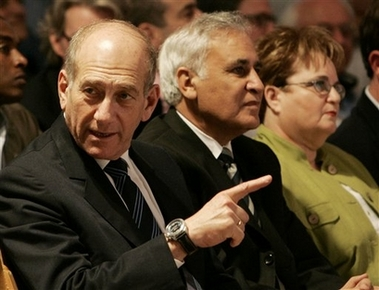
Israeli Prime Minister Ehud Olmert,
left, Israeli President Moshe Katsav and his wife Gila attend a ceremony
to lay the cornerstone of the National Campus for the Archeology of Israel
in Jerusalem Sunday Oct. 15, 2006. [AP] |
The official quoted Olmert as saying that Abbas is demanding the release of
Palestinian prisoners as a condition for holding the meeting. Olmert said there
would be no prisoner release until Hamas-linked militants in the
Gaza
Strip release an Israeli soldier, Cpl. Gilad Shalit.
"We offered to meet with Abu Mazen, but apparently he is not interested,"
Olmert was quoted as telling a meeting of lawmakers from his Kadima party. "He
is conditioning a meeting on the release of prisoners and we will not release
any prisoners until Gilad Shalit is released." Abbas is also known as Abu Mazen.
The official, who attended the meeting, spoke on condition of anonymity
because he was not authorized to discuss the matter on the record.
Olmert announced late last month that he soon hoped to hold a long-delayed
meeting with Abbas, a political moderate locked in a power struggle with Hamas.
But the preparations have foundered over the prisoner issue.
Abbas has said he wants assurances the meeting will deal with more than the
fate of Shalit, though Palestinian officials say he has not insisted on a
prisoner release.
Saeb Erekat, a Palestinian lawmaker who is close to Abbas, said preparations
remain on track. "The efforts to schedule a meeting are still ongoing, and both
sides are determined to ensure a successful meeting," he said.
Relations between
Israel and the Palestinians have deteriorated since
the radical Islamic group Hamas won Palestinian parliamentary elections in
January. Israel has boycotted the militant group, which is committed to the
destruction of the Jewish state, but considers Abbas an acceptable negotiating
alternative.
Olmert and Abbas have met only once, at a brief informal breakfast in Jordan,
since the Israeli leader was elected in March. They were planning a more
substantive meeting when Shalit was captured in June, putting peace efforts on
hold.
Israel has been carrying out a widespread offensive in Gaza since Shalit was
captured. Israeli forces have killed 21 Palestinians in fighting since Thursday.
Most of the dead were militants, but two minors, ages 10 and 14, and a
29-year-old woman also were killed.
Israel says the latest raid is aimed at targeting the repeated fire of
homemade rockets from the northern Gaza Strip. "We cannot allow ourselves to
accept this pace of rocket fire," Olmert said in Sunday's Cabinet meeting.
Several rockets have landed in southern Israel; no serious injuries have been
reported.
During the Cabinet meeting, senior military officials said they believe Hamas
has smuggled anti-aircraft weapons into Gaza for the first time, participants
said. If true, this could pose a serious challenge to Israel, which relies
heavily on its air force to attack militants in Gaza.
Abbas has been trying to pressure Hamas to moderate its views, but efforts to
form a national unity government, which could lead to new peace talks have
stalled. The militants have demanded the release of hundreds of Palestinians
jailed by Israel.
Nevertheless, Olmert said he hoped a summit would lead to broader peace
talks. Negotiations have been frozen for years, with both sides refusing to
carry out their initial obligations under the internationally backed "road map"
peace plan.
During Rice's visit early this month, Olmert reportedly promised to "create a
better environment" and return to peacemaking.
