GAZA - Mediation efforts by Qatar's foreign minister failed to resolve a
stalemate between rival Palestinian leaders that has prevented the formation of
a unity government, a senior Palestinian official said on Tuesday.
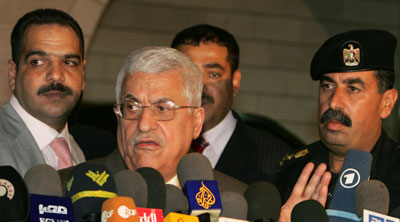
Palestinian President Mahmoud Abbas
(C) talks to the media after his meeting with Qatar's Foreign Minister
Sheikh Hamad bin Jassim bin Jabr al-Thani in Gaza October 9, 2006. Qatar
put forward proposals to Hamas leader Khaled Meshaal on Monday designed to
end a standoff that has prevented the formation of a new Palestinian
government and triggered the worst internal violence in a decade.
[Reuters] |
The impasse has triggered the worst internal fighting in a decade as the
Hamas-led Palestinian government of Prime Minister Ismail Haniyeh became
embroiled in a bitter power struggle with President Mahmoud Abbas of the
once-dominant Fatah faction.
"The differences on the core issues have remained ... in the light of
tonight's talks it does not seem as if we are closer to an agreement," senior
Abbas aide Yasser Abed Rabbo said.
The key obstacles to the formation of a unity government have been Hamas'
refusal to participate in any administration that recognises Israel and to
renounce armed struggle against the Jewish state.
Abbas held two meetings with Qatari Foreign Minister Sheikh Hamad bin Jassim
bin Jabr al-Thani on Monday night, the second of which spilled over into the
early hours of Tuesday morning.
Sheikh Hamad held back-to-back talks with Abbas and Haniyeh in the Gaza Strip
after meeting earlier in the day with Hamas leader Khaled Meshaal in Damascus.
According to Abed Rabbo, the talks failed because Hamas continued to refuse
to recognise Israel and to accept previously signed agreements with the Jewish
state.
"We will continue the dialogue over these points but no agenda for a unity
government can succeed unless these points are resolved," he said.
Abbas said the Qatari mediation effort would continue but Sheikh Hamad left
the coastal territory early on Tuesday and it was not clear if or when he would
return.
FAILURE MAY MEAN EARLY ELECTIONS
Abed Rabbo warned that failure of the Qatari mediation would probably force
early Palestinian elections.
"This initiative is the last political effort that is being exerted and the
opportunity must be seized because the alternative is to hold early elections,"
he said.
Palestinian politicians said the Qatari proposals included forming a
government of so-called technocrats and convening a meeting between Abbas and
Meshaal, whose Hamas movement won Palestinian elections in January.
Fifteen people have been killed in clashes between Hamas and Fatah since
talks on a coalition government foundered, the worst internal violence in Gaza
and the West Bank since the start of Palestinian self-rule in 1994.
Abbas aides said Meshaal provided Sheikh Hamad with a counter-proposal by
Hamas, the details of which were not disclosed. "Abbas was furious and rejected
the Hamas paper," a senior Abbas aide said.
Hamas officials say any agreement has to be based on the so-called
"Prisoners' Document", penned by Palestinians in Israeli jails, that Hamas
agreed to in June after amendments.
The document calls for negotiations with Israel if the Jewish state withdraws
from land it has occupied since 1967, resistance focused on peaceful means and a
unity government.
Hamas, which rejected suggestions at the time that the deal implied it
accepted Israel's existence, says recognition and any end to armed struggle
would be futile as long as the Jewish state refuses to withdraw from all
occupied land.
The Islamist movement was established in 1987 during the first Palestinian
uprising for statehood. It spearheaded a suicide bombing campaign against
Israel, but has gone further than other Palestinian factions in respecting a
truce.
In Israeli-Palestinian violence, residents in the southern Gaza Strip said
that a Palestinian was shot dead by Israeli gunfire on Tuesday. The Israeli army
declined comment.
