Asia-Pacific
S. Korean nominated as UN leader
(Reuters)
Updated: 2006-10-10 07:15
 |
Large Medium Small |
UNITED NATIONS - South Korean Foreign Minister Ban Ki-moon was formally nominated as U.N. secretary-general on Monday, his day of victory overshadowed by North Korea's nuclear weapons test.
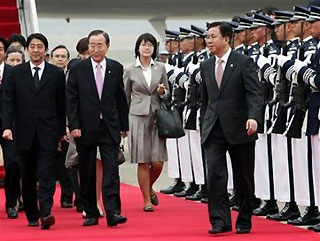 Japan's Prime Minister Shinzo Abe (L) and South Korea's Foreign Minister Ban Ki-Moon inspect South Korea's honour guards upon his arrival at a Seoul military airbase, October 9, 2006. [Reuters] |
The 192-member U.N. General Assembly must give final approval to Ban's nomination, which usually follows within a week or two. That vote is expected to be positive for the first Asian secretary-general since U Thant of Burma in 1961-1971.
Ban, speaking to reporters in Seoul after the Security Council vote, said North Korea's reported test was "a grave and direct threat to peace and stability on the Korean peninsula and northeast Asia."
"This should be a moment of joy but instead I stand here with a very heavy heart," he said.
Ban spoke to U.S. Secretary of State Condoleeza Rice three times on Monday -- once directly and twice through conference calls, including one among foreign ministers from that included China, Japan and Russia.
"I think the fact the candidate is current foreign minister of the Republic of Korea is an asset in dealing with the situation in the Korean peninsula that we are now facing," Japan's U.N. Ambassador Kenzo Oshima told reporters.
Some diplomats, including Oshima, have speculated that North Korea's October 3 announcement of plans to carry out the underground nuclear test was timed, in part, to coincide with Ban's candidacy in an effort to get world attention.
U.S. URGES REFORM
Ban, 62, would be the eighth secretary-general in the world body's 60-year history. He will inherit a bureaucracy of 9,000 staff, a $5 billion budget and more than 90,000 peacekeepers in 18 operations around the globe that cost another $5 billion.
U.S. Ambassador John Bolton immediately emphasized the need for U.N. management reform.
"With this vote today, the winds of change at the United Nations have started to rise and we are looking forward to some significant steps in the reform process when he takes office," he told Reuters.
Annan, in his own statement, welcomed the nomination. He said he had the "highest respect" for Ban and would do "everything possible to ensure a smooth transition," a U.N. spokesman said.
The low-keyed Ban will be a contrast to Annan, a Ghanaian who in his first five years won a Nobel Peace Prize and was sometimes dubbed a diplomatic rock star, before financial scandals took over headlines in the past few years.
Among colleagues in Seoul, everyone seemed to agree that Ban is pleasant and hard-working.
Jang Sung-min, a former presidential aide and member of parliament said, "He probably won't do a bad job. It is really hard to think of a problem with Ban. Maybe that's his strong point -- that there's nothing peculiar about him."
Although Annan was criticized regularly in the United States, Europeans viewed him more favorably and many so far have ignored the imminent arrival of Ban.
Ban won't be "the sort of activist diplomat, ready to seize the initiative, which we saw in Kofi Annan," said Dick Leurdijk, a U.N. expert at the Netherlands Clingendael Institute of International Relations.
"I think he will be more like his Asian predecessor U Thant, who just took care of the shop," he said.