Asia-Pacific
North Korea hails historic nuclear test
(Agencies)
Updated: 2006-10-09 11:37
 |
Large Medium Small |
Chronology of North Korea's nuclear weapons development
Text of North Korea's nuke announcement
US confirms 'seismic event' in North Korea
North Korea said Monday it has performed its first-ever nuclear weapons test, which would confirm that the country has a working atomic bomb as it has long claimed. (Full Coverage on North Korea's Nuclear Crisis)
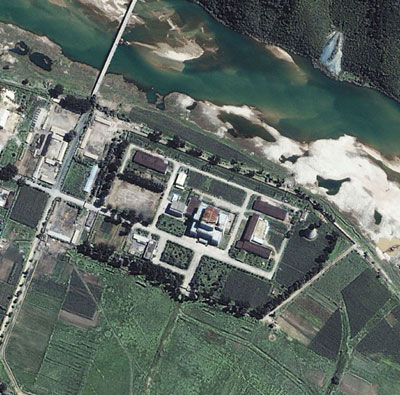 File IKONOS satellite image of the Yongbyon nuclear facility, located about 100 kms (62 miles) north of Pyongyang, taken August 13, 2002. North Korea has carried out an underground nuclear test, the North Korea's Central News Agency (KCNA) said on October 9, 2006. [Reuters] |
The country's official Korean Central News Agency said the underground test was performed successfully "with indigenous wisdom and technology 100 percent," and that no radioactive material leaked from that test site.
"The test is 100 percent safe," said the KCNA.
"It marks a historic event as it greatly encouraged and pleased the (Korean People's Army) and people that have wished to have powerful self-reliant defense capability," KCNA said. "It will contribute to defending the peace and stability on the Korean Peninsula and in the area around it."
South Korea's presidential Blue House said a tremor had been detected in North Korea on Monday.
It said South Korea's Institute of Geoscience and Mineral Resources had detected a tremor of a magnitude 3.58 to 3.7 at 0135 GMT.
The nuclear test was conducted at 10:36 a.m. (0136 GMT) in Hwaderi near Kilju city, South Korea's Yonhap news agency reported, citing South Korean defense officials.
North Korea's potential nuclear test was equivalent to 550 tons of TNT, a state-run South Korean geological institute said, which would be far smaller than the nuclear bombs dropped on Japan in World War II.
"It amounts to detonating 550 tons of trinitrotoluene, or TNT, at once," said Park Chang-soo, a spokesman of the Korea Institute of Geoscience and Mineral Resources.
North Korea claimed earlier Monday that it successfully conducted its first nuclear bomb test.
The atomic bomb that was dropped on Hiroshima of Japan on August 6, 1945, had the destructive power of about 15,000 tons (33 million pounds) of TNT. Another bomb that was dropped in Nagasaki was equivalent to about 21,000 tons (4,630 pounds) of TNT.
China resolutely opposes the nuke test
The Chinese government is resolutely opposed to the nuclear test by the Democratic People's Republic of Korea (DPRK), Chinese Foreign Ministry said in a statement Monday.
"The DPRK ignored universal opposition of the international community and flagrantly conducted the nuclear test on October 9. The Chinese government is resolutely opposed to it," the statement said.
It said China strongly demands the DPRK live up to its commitment to non-nuclearization on the Korean Peninsula, stop any activity that may worsen the situation and return to the six-party talks.
It has been the firm, unshakable and consistent stance of the Chinese government to realize non-nuclearization on the Korean Peninsula and oppose proliferation of nuclear weapons, the statement said.
The Chinese government calls for calm response from all parties concerned and urges them to stick to peaceful resolution of the issue through consultations and dialogues, the statement said.
It said that maintaining peace and stability in the Northeast Asia region conforms to the common interests of all parties concerned.
White House: Nuclear test a provocative act
A North Korean nuclear test would constitute a "provocative act" and Washington expects the U.N. Security Council to take immediate actions, the White House said early on Monday.
"U.S. and South Korean intelligence detected a seismic event Sunday at a suspected nuclear test site in North Korea," White House spokesman Tony Snow said in a statement.
"North Korea has claimed it conducted an underground nuclear test. A North Korean nuclear test would constitute a provocative act, in defiance of the will of the international community and of our call to refrain from actions that would aggravate tensions in northeast Asia," said Snow.
"We expect the Security Council to take immediate actions to respond to this unprovoked act," he said.
North Korea said on Monday it had safely and successfully carried out an underground nuclear test, flying in the face of a warning from the Security Council.
The U.S. Geological Survey said it had detected a 4.2 magnitude quake in North Korea at 10:35 local time (0135 GMT) on Monday, confirming a similar report from South Korea.
"The United States is closely monitoring the situation and reaffirms its commitment to protect and defend our allies in the region," said Snow.
The move came about a week after the country announced it would undertake an unprecedented nuclear test under the condition where safety is firmly guaranteed.
In a statement issued last Tuesday, the DPRK Foreign Ministry said it "will never use nuclear weapons first."
The October 3 announcement drew deep concerns of the international community.
The United Nations Security Council on Friday unanimously adopted a presidential statement, urging the DPRK to return immediately to the six-party talks.
"The Security Council urges the DPRK to return immediately to the six-party talks without precondition, and to work toward the expeditious implementation of the September 19, 2005, Joint Statement, and in particular to abandon all nuclear weapons and existing nuclear programs," the statement said.
The test came amid intense diplomatic efforts aimed at heading off the move.
Japan's new prime minister, Shinzo Abe, arrived Monday in Seoul for meetings with President Roh Moo-hyun to address the nuclear issue as well as address strains in relations between Japan and South Korea over territorial and historical disputes.
Shen Jiru, a researcher at the Chinese Academy of Social Sciences said: "It is expected, since they announced they would do it last week. It deals another severe blow to the current international nuclear non-proliferation regime. I personally feel it is very regrettable. The situation in Northeast Asia has become extremely complicated.
Speculation over a possible North Korean test arose earlier this year after US and Japanese reports cited suspicious activity at a suspected underground test site.