UNITED NATIONS - Iran is prepared to negotiate a suspension of its most
sensitive nuclear work if it receives fair guarantees in talks with major
powers, Iranian President Mahmoud Ahmadinejad said on Thursday.
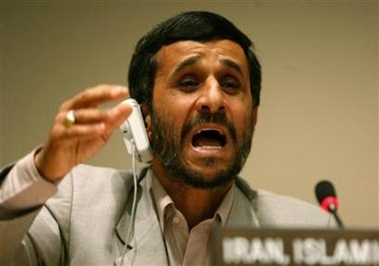
Iran's President Mahmoud Ahmadinejad
speaks at a news conference during the 61st session of the U.N. General
Assembly in New York September 21, 2006.
[Reuters] |
He told a news conference at the United Nations headquarters in New York that
talks with the European Union on Iran's nuclear program were on the right track
and he hoped no one would try to sabotage them, an apparent reference to the
United States.
"We believe those negotiations are moving on the right path. Hopefully others
will not disrupt the work -- in small ways perhaps. We think it is a
constructive path to take," he said.
Responding to a U.N. Security Council demand that Iran suspend uranium
enrichment, which can produce fuel for power stations or bombs, he said Tehran
was prepared to discuss such a move but gave no time-frame for doing so.
"We have said that under fair conditions and just conditions we will
negotiate about it," the president said.
While there have been hints at progress in recent talks between Iran and EU
foreign policy chief Javier Solana, this was the most explicit statement by an
Iranian leader that Tehran is seriously considering complying with the key
condition for talks on broad cooperation with the West.
After Iran ignored a U.N. deadline to halt enrichment by August 31, foreign
ministers of the United States, Russia, China, Britain, France and Germany
agreed this week to give Solana until early October to reach a deal with Tehran
on terms for starting talks, diplomats said.
If Iran did not agree to suspend enrichment at that point, the six powers
would seek U.N. sanctions on Iran, they said.
Ahmadinejad insisted that Iran's nuclear program was peaceful and fully open
to inspection and asked why the United States supported other states in his
region which were known to make nuclear weapons, an apparent reference to
Israel, Pakistan and India.
Following up the main thrust of his U.N. General Assembly speech on Tuesday,
Ahmadinejad questioned the legitimacy of the Security Council to sit in judgment
on others when its own members were involved in "oppression".
