Asia-Pacific
Abe elected Japan ruling party chief, set to be PM
(Reuters/AP)
Updated: 2006-09-20 14:13
 |
Large Medium Small |
Tokyo - Shinzo Abe, an advocate of a bigger say for Japan in global affairs, was elected president of Japan's ruling party by an overwhelming majority on Wednesday, setting the stage for his election as prime minister next week.
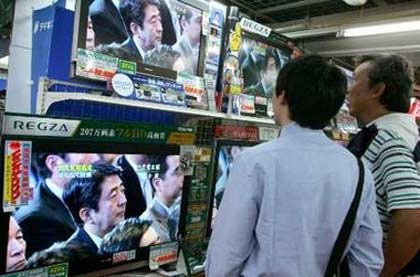 Customers look at TV screens showing Japan's Chief Cabinet Secretary Shinzo Abe during the ruling Liberal Democratic Party's presidential election at an electrical retailer shop in Tokyo September 20, 2006. [Reuters] |
( Related:China urges Abe to make efforts to improve bilateral ties)
Abe, who turns 52 on Thursday and would be Japan's first prime minister born after World War Two, has pledged to rewrite the nation's US-drafted pacifist constitution, tighten already close ties with Washington, and strive to repair ties with China and South Korea, damaged by outgoing Prime Minister Junichiro Koizumi's annual visits to Tokyo's Yasukuni Shrine for war dead.
The conservative Abe's widely anticipated victory over two rivals all but ensures his election as prime minister when parliament convenes for a vote on September 26, because of the ruling Liberal Democratic Party's grip on the powerful lower chamber.
Abe has also promised to keep on track the economic reforms begun by the maverick Koizumi, who took power in 2001 pledging to shake up his party and reduce the heavy hand of government on the long-stagnant economy.
Return to Nationalism?
The son of a foreign minister and grandson of a prime minister, Abe has campaigned on forging a more assertive Japan. He would seek to revise the pacifist constitution to give the military more freedom of action, take a hard line with North Korea and bolster the security alliance with Japan's top ally, the United States.
On Tuesday, Abe hit on his main themes at appearances in Tokyo.
"The time has come to create a country appropriate for the 21st century," he told supporters. "It is important to start building a country with all generations of people working together."
Abe, who joined parliament in 1993 and now serves as chief Cabinet Secretary, comes to the race with the essentials for victory: high support ratings inside and outside the party and the blessing of his mentor, Prime Minister Junichiro Koizumi.
Because Abe's victory appears certain, his competition has been lackluster. Challengers such as Finance Minister Sadakazu Tanigaki and Foreign Minister Taro Aso never came close to rivaling Abe in popularity or a vision for Japan's future.
The lack of competition, however, has led to a lack of clarity about Abe's policies.
One looming question for Japan's neighbors is how far Abe will push his vision of a country freed from the restraining legacy of World War II, in which Tokyo's attempt at regional hegemony left Japan and much of Asia in ruins.
Abe, for instance, supports revisionist history textbooks that teach students to take pride in their nation rather than focus on the dark accounts of Japanese atrocities and aggression. He is also a proponent of the Yasukuni war shrine, which honors war criminals among the country's war dead.
He has compounded this conservative image by questioning whether every prime minister must repeat Japan's standard apology for its wartime actions. When North Korea tested several missiles in July, Abe suggested a look into whether the constitution would allow Japan to conduct a pre-emptive military strike.
It was unclear how that approach would affect Japan's relations with China and South Korea, two victims of Japanese aggression who have refused to meet with Koizumi because of his visits to the Tokyo war shrine.
If he ultimately becomes prime minister, Abe will take the helm of a Japan in transition.
After five years under Koizumi, reforms have made Japan a more competitive market, powering the economy out of a decade-long slowdown but also widening an increasingly troubling gap between rich and poor.
Japan has already started shedding its postwar pacifism. Koizumi pushed for, and won, the power to dispatch the military in unprecedented non-combat roles to help US-led missions in Afghanistan and Iraq, despite domestic opposition.
But there will be differences as well. Abe is seen as more willing to increase the pressure on North Korea to back down on its nuclear weapons program and resolve the cases of Japanese citizens it abducted in the 1970s and 1980s.
His eagerness to reassess Japan's place in the world has support among conservatives in his party.
"I can relate to his stance toward the constitution ... and also the belief that Japan needs to look closely at what kind of country it wants to be,” former Foreign Minister Nobutaka Machimura said after an Abe rally Tuesday.