BEIRUT - British Prime Minister Tony Blair began a visit to Lebanon on Monday
as troops and riot police deployed in central Beirut to handle planned protests
against his stance during Israel's 34-day war with Hizbollah.
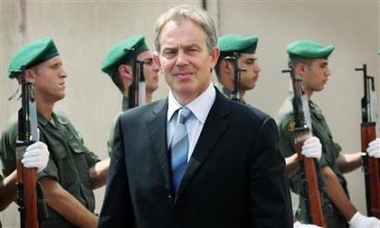
Prime Minister Tony
Blair in Ramallah, September 10, 2006.
[Reuters] |
Blair, who angered many Lebanese for his refusal to call for an early
ceasefire in the conflict, was due to hold talks with Prime Minister Fouad
Siniora on the truce in effect since August 14 and Britain's contribution to
postwar reconstruction.
Siniora and Foreign Minister Fawzi Salloukh greeted Blair at the airport,
which reopened fully last week after Israel lifted an eight-week blockade on
Lebanon's airport and ports.
Security forces sealed off Beirut's central district to traffic for Blair's
visit, his first to Lebanon. Pro-Syrian political parties and students have said
they will stage demonstrations against the British prime minister.
Blair had been expected to meet Parliament Speaker Nabih Berri, an ally of
Hizbollah, but an aide to the Shi'ite Muslim politician said he left on a
private trip abroad on Saturday.
The aide declined to say whether Berri had deliberately snubbed Blair, but
said his trip had been previously planned.
An aide to Blair said two Hizbollah ministers in the cabinet would not attend
a planned meeting of the British premier with the Lebanese government.
Top Shi'ite cleric Sayyed Mohammad Hussein Fadlallah said on Sunday Blair was
not welcome because of his support for Israel and Washington. He also criticized
Blair for allowing U.S. arms to be shipped via Britain to Israel for use against
Lebanon.
"SLAUGHTERING OUR CHILDREN"
Fadlallah said Blair should have been told to stay away so he would "know we
are not so naive as to welcome him when he has contributed to killing us and
slaughtering our children."
The conflict cost the lives of nearly 1,200 people in Lebanon, mainly
civilians, and 157 Israelis, mostly soldiers.
During the war Britain allowed U.S. flights loaded with bombs for Israel to
refuel at an airport in Scotland. Blair also drew criticism at home for standing
with President Bush in opposing calls for an early ceasefire.
Blair began his Middle East tour in Israel on Saturday on a peace drive that
analysts say is aimed partly at countering criticism of his pro-U.S. stance
during the Lebanon war and partly at bolstering his political legacy.
Last week Blair was forced to concede he will leave office within a year to
quell a rebellion in his Labour Party.
Blair said on Sunday the international community should deal with a unity
Palestinian government if it breaks with the policies of the boycotted Hamas-led
administration.
"I believe that such a government, based on the Quartet requirements, does
offer the possibility of re-engagement by the international community," Blair
said.
A Hamas spokesman said President Mahmoud Abbas and Prime Minister Ismail
Haniyeh had achieved a breakthrough in talks that could see the formation of
such a government within days.
The Quartet of Middle East peace brokers - the United States, the European
Union, the United Nations and Russia - have cut aid to Hamas's administration,
demanding it recognize Israel, renounce violence and accept past interim peace
deals.
Hamas, an Islamist militant group whose charter calls for Israel's
destruction, has so far resisted international pressure and calls by Abbas to
soften its policy toward the Jewish state.
