WASHINGTON - The United States expects the U.N. Security Council to overcome
Russian and Chinese misgivings and approve sanctions on Iran, senior U.S.
officials said on Wednesday.
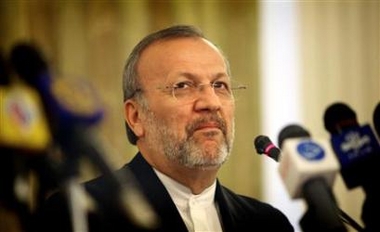
Iran's Foreign
Minister Manouchehr Mottaki speaks with journalists during a news
conference in Tehran September 6, 2006.
[Reuters] |
Undersecretary of State Nicholas Burns will join colleagues from Russia,
China, Britain, France, Germany and the European Union in Berlin on Thursday to
discuss a joint response to Iran's refusal to obey a U.N. order to halt nuclear
enrichment activities by August 31.
Undersecretary of State Robert Joseph, the top U.S. non-proliferation
official, said the United Nations had already struck the "fundamental bargain"
by agreeing that sanctions should be the next step.
A resolution passed on July 31 stated that the Security Council would move
toward sanctions if Iran did not meet the August 31 deadline.
Since Iran defied the deadline, "I think China, like Russia and the other
states that voted for the resolution, will support what is called for in the
resolution," Joseph told a news briefing.
U.S. officials are aiming for Security Council action by month's end.
However, State Department spokesman Sean McCormack, in a separate briefing, said
Washington would stop pushing for sanctions if Iran suspended uranium
enrichment.
Joseph said the world could not wait while Tehran "plays for time" and moves
closer to a nuclear weapon, which it could acquire by the end of the decade.
Iran's postponement of a planned meeting with European Union foreign policy
chief Javier Solana on Wednesday was another attempt at delay, he said.
Despite U.S. confidence, it is by no means certain that other major powers
will agree to impose sanctions on Iran. Russia and China are both uneasy with
the use of sanctions in general and reluctant to harm trade with Iran. Both have
revived their objections while some Europeans are also expressing concerns.
The United States and its allies have accused Iran of trying to produce
nuclear weapons under the guise of a nuclear energy program. Tehran denies the
charge.
INVESTORS BRIEFED
U.S. officials have told some investors they are confident of enacting
measures to press Iran's leaders to negotiate, one investor with ties to the
administration said.
The United States and its partners have offered Iran, the world's fourth
major oil producer, economic and political incentives if it abandons
weapons-related activities.
They expect to impose sanctions on a graduated basis, beginning by banning
foreign travel and closing overseas bank accounts of Iranians involved in
nuclear, chemical, biological and missiles programs.
U.S. and European officials said they still need to decide which specific
individuals to target, when sanctions would take effect, how long they would
last and how to enforce them.
Meanwhile Washington is encouraging other countries to use existing national
and international authorizations to halt Iran's trade in sensitive technologies.
It is also trying to persuade international banks to end business with Iran.
Stuart Levey, Treasury under-secretary for terrorism and financial intelligence,
will be in Europe next week for more talks on drying up Iran's financial flows.
At the same time, the State Department said it was providing security for
former Iranian President Mohammed Khatami on a unprecedented U.S. visit.
Massachusetts Gov. Mitt Romney, a possible 2008 Republican presidential
candidate, said his state would not protect Khatami during a visit to Harvard
University next weekend but McCormack said the department's diplomatic security
office would fill the gap.
Khatami on Thursday was to speak at Washington's National Cathedral, where
many prominent Americans worship.
