JERUSALEM - Israel said it would lift its stifling air and sea blockade of
Lebanon on Thursday, marking a crucial breakthrough in international efforts to
rebuild from the war between Israel and Hezbollah guerrillas.
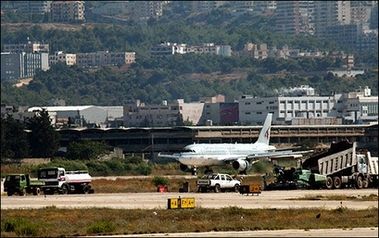
Lebanese employees
continue their work on reconstructing a runway at Beirut airport as a
Qatari Airways plane touches down despite the Israeli blockade on 04
September 2006. Israel will lift the air and sea blockade imposed on
Lebanon at 1500 GMT after receiving international assurances over an arms
embargo on Hezbollah, the prime minister's office said.
[AFP] |
The move, announced Wednesday by the prime minister's office, will be the
first major test for the U.N. force charged with keeping the peace and
preventing arms shipments from reaching Hezbollah.
It was also a victory for U.N. Secretary-General Kofi Annan, who has
repeatedly demanded that Israel end the blockade, and showed some disagreements
can be resolved with U.N. mediation.
Israel is slowly pulling its troops out of southern Lebanon as international
peacekeepers arrive. However, a deal on the thorniest issue, the return of two
Israeli soldiers whose July 12 capture sparked the fighting will be far more
difficult to broker, since Israel has demanded their unconditional release but
Hezbollah has insisted on a prisoner swap.
Israel imposed an air, land and sea blockade shortly after the war against
Hezbollah began. Israel said it was vital to stopping the guerrilla group from
resupplying itself with arms from its major patrons, Syria and Iran.
There are no estimates of losses from the blockade, but at one point it
caused severe fuel shortages in Lebanon, leading to long lines at gas stations
and forcing the electric company to ration power. In recent weeks, some supply
ships were allowed to dock after coordinating with Israel, easing the fuel
crisis and allowing the electricity authority to lift part of the rationing.
Israel had said it would not end the blockade until a beefed up U.N. force in
southern Lebanon could prevent arms shipments to Hezbollah.
On Wednesday, a statement from Israeli Prime Minister Ehud Olmert's office
said Annan and Secretary of State Condoleezza Rice told Olmert the international
force was ready to monitor the airports and seaports, so Israel agreed to lift
the blockade at 6 p.m. (11 a.m. EDT) Thursday.
"We have said from the beginning of the blockade ... that as soon as
international troops would arrive, Israel would hand over the implementation of
the (arms) embargo to the international troops," Israeli government spokesman
Miri Eisin said.
When Israel's decision was announced at a political gathering in Lebanon on
Wednesday evening, the crowd broke into noisy applause.
Lebanese President Emile Lahoud, a staunch supporter of Hezbollah, hailed the
decision as a victory for Lebanon.
"Lebanon's firm position and its refusal to bow to pressure or blackmail
forced Israeli officials to take the decision on lifting the blockade," he said,
adding that Israel still has to remove its forces from south Lebanon.
Eisin said Israel was still concerned about arms smuggling to Hezbollah
across Lebanon's border with Syria.
"Until that issue is resolved, Israel will continue to reserve our right of
self defense to continue to implement the embargo against any arrival of weapons
to Hezbollah from Syria," she said, in what appeared to be an implied threat to
conduct airstrikes against vehicles carrying arms shipments.
Israel has called for international troops to be stationed along the border,
but Lebanon says it can patrol the area itself with only technical support from
the U.N. mission. Lebanon has deployed thousands of troops there, sealing off
smuggling routes along the rugged mountain frontier. Syria also has promised to
improve security along the frontier.
German experts were expected to arrive at Beirut airport Wednesday and German
naval forces were to take positions along the coast within two weeks, the
Israeli statement said. Until then, Italian, French, British and Greek forces
would secure the area, it said.
A sticking point in lifting the siege was Israel's demand that foreign troops
be in place first, as opposed to Lebanon's insistence that the blockade be ended
before it asked for foreign assistance, according to Lebanese officials.
Under the U.N.-brokered deal, the Beirut government sent a letter to the
United Nations on Wednesday evening about the time the Israeli government
announced the lifting of the blockade, requesting that Germany monitor shipping
into Lebanon, a Lebanese official said, speaking on condition of anonymity
because of the sensitivity of the agreement.
Airport security will be handled solely by Lebanese authorities with only
technical support from U.N. peacekeepers, the official said.
About 3,250 U.N. troops are in Lebanon, and U.N. officials expect the number
to reach 5,000 by late next week. A U.N. cease-fire resolution calls for a
15,000-member U.N. force to patrol south Lebanon, along with 15,000 Lebanese
soldiers.
French peacekeepers began their first patrols of Lebanon's bomb-ravaged
border Wednesday and were greeted by villagers waving flags and taking pictures.
But in a reminder of the fragility of the peace, two Lebanese explosives
experts were killed and one was seriously wounded in the village of Aita
al-Jabal as they tried to defuse an artillery shell left over from the war,
Lebanese officials said.
The 34-day war, which ended Aug. 14, killed 855 Lebanese and 159 Israelis.
During the fighting, Hezbollah fired nearly 4,000 rockets into northern Israel,
forcing about 300,000 residents to evacuate and causing hundreds of millions of
dollars in damage to buildings and the economy.
Lebanon estimates that Israeli airstrikes and ground attacks caused $3.6
billion in damage. International donors pledged $1 billion to Lebanon last week,
but rebuilding efforts could not begin in earnest until Israel ended the
blockade.
Enforcing the blockade during the fighting, Israeli warplanes attacked Beirut
airport's runways and stopped ships from entering Lebanon without permission.
Roads and bridges linking Lebanon with Syria, Lebanon's only land link to the
Arab world, were destroyed.
Israel softened the blockade in recent weeks, allowing in some commercial
flights and aid ships. Gulf Air announced Wednesday it will start flying to
Lebanon on Saturday.
The land route was also reopened, but Israel continued to warn against flying
or sailing into Lebanon without prior approval.
