STOCKHOLM - International donors pledged more than $940 million for immediate
relief efforts for war-torn Lebanon, nearly double the target, organisers of an
aid conference in the Swedish capital said on Thursday.
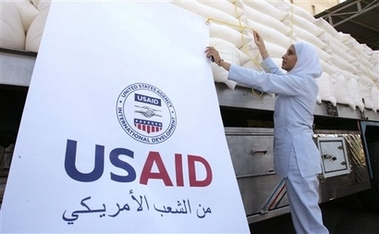
A Jordanian worker fixes a sign on a
truck loaded with humanitarian aid donated by the U.S. Agency for
International Development, east of Amman, Jordan, Thursday, Aug. 31, 2006.
The United States is donating wheat to Lebanon in a gesture of goodwill,
the U.S. ambassador to Jordan said. [AP] |
"An amount exceeding $940 million was pledged at the Stockholm conference,"
said a final chairman's statement released after the meeting.
"This amount is in addition to previous pledges, making a total of over $1.2
billion available for recovery and reconstruction." The statement said the
larger figure included funds for short-term as well as long-term reconstruction.
Lebanese Prime Minister Fouad Siniora told the conference the pledges "show
that the Lebanese people are not alone".
The closing statement also urged Israel to heed a call from United Nations
Secretary-General Koffi Annan to lift its six-week-old sea and air blockade of
Lebanon and urged that U.N. Resolution 1701 be fulfilled.
The Swedish government, the meeting's host, had set a goal of $500 million in
donor promises for Lebanon, which says a 34-day war between Israel and Hizbollah
guerrillas inflicted billions of dollars in damage to its infrastructure and
economy.
"Lebanon, which only seven weeks ago was full of hope and promise, has been
torn to shreds by destruction, displacement, dispossession, desolation and
death," Siniora told representatives of the more than 60 governments and
organisations at the gathering.
The funds are aimed at Lebanon's immediate relief needs, from shelter for
those who lost their homes in Israel's war with Hizbollah to the removal of
unexploded bombs.
Lebanon hopes to hold a bigger conference later this year to raise money for
longer-term reconstruction.
Stockholm will play host to a smaller gathering on Friday to discuss
humanitarian needs in the Palestinian territories.
The Lebanon conference took place amid growing Western concern that cash
handouts from Hizbollah to those whose homes were destroyed or damaged would
entrench the guerrillas' popularity.
Israel began bombarding Lebanon after Hizbollah guerrillas captured two
Israeli soldiers and killed eight in a cross-border raid. Nearly 1,200 people in
Lebanon, mainly civilians, and 157 Israelis, mostly soldiers, were killed during
the war.
Siniora played down any involvement by Hizbollah in the rebuilding process
using funds raised in Stockholm.
"The conference is being called to assist the Lebanese government, all will
be channelled through the government," he told a news conference. "This idea
that it will be siphoned one way or another to Hizbollah is a fallacy."
UNEXPLODED BOMBS, HOMES, OIL SLICK
Lebanese officials said a priority for short-term relief was 10,000
prefabricated homes for some of the 1 million people displaced by the
destruction.
Another goal was the removal of unexploded ordnance, including thousands of
cluster bombs.
"What is particularly discouraging ... is to see how many cluster bombs were
used in the last 72 hours of the war," U.N. emergency relief coordinator Jan
Egeland told Reuters Television.
"These are now unexploded small bombs that are waiting for the children who
come back to their schools, to hospitals, to their homes and their villages. It
should not be like that," he said, calling for international assistance in their
removal.
On Wednesday, Siniora said his government would pay $40,000 to each family
made homeless to help them rebuild.
Lebanon plans to earmark $52 million for further work on clearing an oil
slick that has spread along its coast since the bombing of the Jiyyeh power
station last month.
According to U.N. and Lebanese estimates, Israeli strikes on the plant's fuel
storage tanks spilled 10,000 to 15,000 tonnes of heavy fuel oil into the
Mediterranean Sea.
