TEHRAN, Iran - Iran defied a U.N. deadline Thursday to stop enriching
uranium, opening the door for sanctions, but U.S. and other officials said no
action would be sought before a key European diplomat meets with Tehran's atomic
chief next week to seek a compromise.
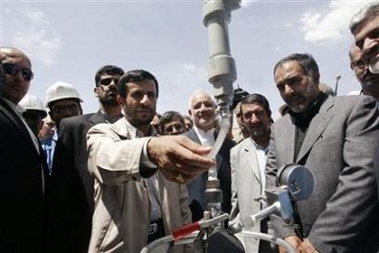
Iranian President
Mahmoud Ahmadinejad (C) inaugurates the Arak heavy-water project 120 miles
southwest of Tehran, August 26, 2006. A defiant Iran faces the threat of
U.N. Security Council sanctions after the world body's atomic watchdog
said Tehran refused to stop work on its nuclear program by a Thursday
deadline. [Reuters] |
Iran's hard-line president, Mahmoud Ahmadinejad, lashed out at the United
States, calling it "tyrannical" and insisting Tehran would not be "bullied" into
giving up the right to use nuclear technology. Other Iranian officials said the
country could withstand any punishment.
President Bush called for "consequences to Iran's defiance," saying the
"world now faces a grave threat from the radical regime in Iran."
"We must not allow Iran to develop a nuclear weapon," Bush said in a speech
in Salt Lake City. He said Washington hoped for a diplomatic solution, but
insisted "it is time for Iran to make a choice" whether to cooperate with the
United Nations.
John Bolton, U.S. ambassador to the United Nations, said the Security Council
would wait to consider possible actions until after the European Union's foreign
policy chief, Javier Solana, met with Ali Larijani, Iran's top nuclear
negotiator, sometime in the middle of next week.
"We're certainly ready to proceed here in New York when we're given the
instructions to do so," Bolton said.
U.N. Secretary-General Kofi Annan also was expected to raise the issue during
a visit to Tehran this weekend.
Midnight Thursday, the last day of the Security Council deadline passed with
no change in the Iranian position.
The formal trigger for possible sanctions was provided by the International
Atomic Energy Agency, based in Vienna, Austria.
In a report Thursday, the U.N. agency confirmed Tehran had not halted uranium
enrichment as demanded by the Security Council and said three years of IAEA
probing had been unable to confirm "the peaceful nature of Iran's nuclear
program" because of lack of cooperation from Tehran.
Iran denies it is trying to acquire atomic weapons in violation of its
commitments under the Nuclear Nonproliferation Treaty. Tehran insists its
nuclear program is peaceful, with the sole aim of producing electricity with
nuclear reactors.
The Security Council voted July 31 to impose the Thursday deadline for Iran
to suspend uranium enrichment and asked the IAEA to report on Tehran's
compliance, dangling the threat of sanctions if Iran refused.
Still, with permanent council members Russia and China opposed to quick and
harsh penalties, the council appeared ready to delay such action. Senior U.N.
diplomats told The Associated Press that Iran had agreed to meet with European
negotiators to try to find a compromise.
Confirming the plans, Bolton said the Security Council would wait to consider
any action until after European Union envoy Javier Solana met with Ali Larijani,
Iran's chief nuclear negotiator, sometime next week.
An official from one nation on the council said the meeting was tentatively
set for Tuesday in Berlin. The official said senior officials from the U.S.,
Russia, China, Britain, France and Germany would meet in the German capital the
following day. Those six nations offered rewards to Iran in June if it gave up
enrichment but warned of U.N. sanctions if it didn't.
Bolton told AP that while Washington "has extensive thoughts on what a
possible U.N. resolution would look like, such discussion will await the outcome
of the Solana meeting with Iran."
Still, he said the IAEA report added further weight to suspicions Iran is
"engaged in activities that are only consistent with a weapons program."
Bolton declined to specify what sanctions the U.S. might seek. But U.S. and
European diplomats have said they are focusing on low-level punishment at first
to win backing from Russia and China. Proposals include travel bans on Iranian
officials or a ban on the sale of dual-use technology to Iran.
More extreme sanctions would be a freeze on Iranian assets or a broader trade
ban, but those would likely be opposed by Russia, China and perhaps others,
particularly since it could cut off badly needed oil exports from Iran.
In Tehran, Foreign Ministry spokesman Hamid Reza Asefi shrugged off the
possibility of sanctions, telling state-run television that Iran "will find a
way to avoid pressure eventually."
Ahmadinejad denounced the United States, accusing it of trying to impose its
will on Iran.
"They claim to be supporting freedom but they support the most tyrannical
governments in the world to pursue their own interests," he told a crowd of
thousands in the northwestern town of Orumiyeh.
"The Iranian nation will not succumb to bullying, invasion and the violation
of its rights," Ahmadinejad said.
While stating "Iran has not suspended its enrichment activities," the
restricted IAEA report, obtained by AP, did not specifically say Iran was
carrying out enrichment Thursday. It said only that Tehran started work on a new
batch Aug. 24.
But a senior official close to the agency said Iran's pilot centrifuge plant
was processing small quantities of uranium gas for enrichment as late as
Tuesday, the last day IAEA inspectors reported back to headquarters on Tehran's
nuclear program.
Iran says it wants to develop a full-scale enrichment program to produce
reactor fuel, but there is growing suspicion the oil-rich country wants to use
enrichment to create fissile material for nuclear warheads.
The rest of the IAEA's report essentially documented a protracted stalemate
between agency inspectors trying to determine if Tehran is seeking to make
weapons and Iranian officials who have repeatedly refused to provide
information.
While the findings on enrichment were expected, they were important because
they provided the formal trigger needed for the Security Council to take up
sanctions.
IAEA officials said the six-page report was hand-carried to the council
chambers at the same time it was posted on the agency's intranet site for the 35
nations on the IAEA's board of governors.
Other key findings in the report from IAEA chief Mohamed ElBaradei:
- New findings of minute particles of highly enriched uranium at an Iranian
technical university implicated in possible military work, although the report
did not specify whether the level was weapons-grade.
- A decision by the Iranians to cut off IAEA access to suspicious diagrams
apparently showing how to mold fissile material into the shape of a warhead and
to destroy notes taken on the document by agency inspectors.
- The temporary barring of U.N. inspectors from an underground facility being
built to house tens of thousands of centrifuges, the backbone of Iran's future
enrichment program.
- Protracted delays in granting multiple entry visas to IAEA inspectors.
U.N. officials told AP that even Olli Heinonen, deputy IAEA director-general
in charge of the Iran investigation, was left dangling. In an unprecedented
move, Iranian officials initially issued him only a one-month visa before
relenting and giving him the usual one-year entry pass Wednesday, a day before
the report was released.
