JERUSALEM - Israel on Wednesday rejected demands from visiting U.N.
Secretary-General Kofi Annan that it immediately lift its sea and air blockade
of Lebanon and withdraw its forces once 5,000 international troops are deployed.
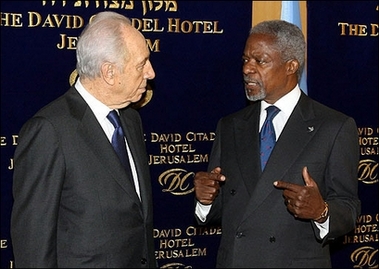
Israeli Deputy Premier
Shimon Peres(L) listens to United Nations Secretary General Kofi Annan as
they meet in Annan's Jerusalem hotel. Annan urged Israel to end its
crippling blockade of war-devastated Lebanon, but failed to extract any
public promise for an immediate halt to the near seven-week siege.
[AFP] |
Prime Minister Ehud Olmert indicated Israel would only allow free movement
after the full implementation of a U.N.-brokered cease-fire that ended 34 days
of fighting between Israel and Lebanon's Hezbollah guerrillas that killed 854
Lebanese and 159 Israelis.
Under the truce, 15,000 Lebanese soldiers and 15,000 international troops are
to be deployed in southern Lebanon and to enforce an arms embargo on Hezbollah.
Olmert, Annan and Israeli Foreign Minister Tzipi Livni all expressed hope
Wednesday that the cease-fire deal would evolve into a full-fledged peace
accord, which Israeli leaders have long hoped to reach with Lebanon. But
Lebanon's premier rebuffed the idea, saying his country would be the last Arab
nation to make peace with the Jewish state.
The vastly different visions of future relations between the two nations
reflect their conflicting priorities. Israel wants to prevent future attacks
from its northern neighbor, while Lebanon is focused on rebuilding from the
recent fighting and trying to maintain peace between its fractious religious
groups, some of whom are sworn enemies of Israel.
The cease-fire deal could be "a cornerstone to build a new reality between
Israel and Lebanon," Olmert said at a news conference with Annan.
Implementation of the truce "gives us a foundation to move forward and settle
the differences between Israel and Lebanon once and for all, to establish a
durable peace," Annan said after meeting with Livni.
But Lebanon has hesitated in reaching a separate agreement with Israel as
long as Israel's conflicts with the Palestinians and Syria are not resolved.
Lebanese Prime Minister Fuad Saniora quashed hopes of a peace deal any time
soon, saying Lebanon "will be the last Arab country that could sign a peace
agreement with Israel."
"Let it be clear, we are not seeking any agreement until there is just and
comprehensive peace based on the Arab initiative," he said in Beirut.
The Arab initiative calls for an Israeli withdrawal from all territories
captured in the 1967 Middle East war and the establishment of a Palestinian
state with east Jerusalem as its capital ¡ª demands Israel rejects.
A Hezbollah legislator also ruled out talks toward a wider peace deal.
"The Lebanese reject negotiations with the Zionist enemy. They consider these
negotiations unnecessary, worthless and have no basis or place," Hussein Haj
Hassan told Al-Jazeera television.
The fighting between Israel and Hezbollah began July 12 when Hezbollah
guerrillas crossed into Israel and attacked an army patrol, killing three
soldiers and capturing two others. Israel has rejected calls for a prisoner swap
to secure their freedom.
Both Annan and Olmert demanded the soldiers' unconditional release, but
Mohammed Fneish, a Hezbollah minister in the Lebanese Cabinet, said that would
not happen.
"There will be no unconditional release. This is not possible," he said.
"There should be a (prisoner) exchange through indirect negotiations."
A third Israeli soldier, Cpl. Gilad Shalit, was seized by Hamas militants in
late June and is being held in the Gaza Strip. His capture touched off a
2-month-old Israeli military offensive in Gaza.
Annan said he would do everything in his power to win the soldiers' release.
He said that during his visit to Lebanon, which ended Tuesday, he discussed
their fate. "I did not get the impression that they are not alive. I believe
they are alive," he said.
Annan also called on Olmert to end the blockade of Lebanon, which is
preventing the country from rebuilding. Lifting the blockade would also
strengthen Lebanon's government.
"I do believe the blockade should be lifted," he said at a news conference
with Olmert.
Israel has said it would lift the blockade when international forces, along
with Lebanese troops, are deployed on Lebanon's border with Syria to prevent the
flow of weapons to Hezbollah from its Syrian and Iranian patrons.
Syria has said it would consider the presence of international troops on its
border a hostile act, and Lebanon has said it would secure the border itself.
Annan said Lebanese authorities assured him they were serious about enforcing
the arms embargo on Hezbollah.
"We need to be flexible, because I don't think there's ever only one way of
solving a problem. We shouldn't insist that the only way to do it is by
deploying international forces," Annan said.
Asked by reporters whether Israel would lift the blockade, Olmert was
evasive, saying only that Israel wanted a full implementation of the cease-fire.
Annan also said he was working to expand the international force in Lebanon
"as rapidly as possible" and to quickly double its current number to 5,000.
"We hope that as we do that, the Israeli withdrawal (from Lebanon) will
continue and by the time we are at that level, Israel will have fully
withdrawn," Annan said.
While Olmert said Israel hoped to leave Lebanon "as soon as possible," he did
not embrace Annan's proposal.
"It isn't on one day the 5,000 come in and on one day all the Israelis
depart," Israeli government spokeswoman Miri Eisin explained later. "It's
something in between, and it's something that has to be ironed out, and it is
being ironed out."
In a meeting later with Palestinian President Mahmoud Abbas, Annan said
Israel also must lift its closure of the Gaza Strip and open crossing points
there. He called for an end to the bloodshed that has killed more than 200
Palestinians since the end of June.
