NAQOURA, Lebanon - U.N. Secretary-General Kofi Annan visited U.N.
peacekeepers in south Lebanon on Tuesday, a day after Italy and Turkey moved to
join the international force there.
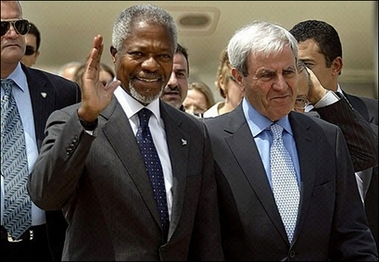
UN Secretary General
Kofi Annan (L), escorted by Lebanese Foreign Minister Fawzi Sallukh, waves
to journalists on arrival at Rafiq Hariri international airport. Annan
visited war-battered south Lebanon to see the destruction caused by the
month-long conflict between Israel and Hezbollah, on the second day of a
regional tour to underpin a fragile truce.
[AFP] |
Annan and his entourage left Beirut Tuesday morning in two white United
Nations helicopters, and landed in Naqoura, a town on the Mediterranean coast
about 4 kilometers (2.5 miles) north of the Israeli border, and home to
headquarters of the U.N. Interim Force in Lebanon, known as UNIFIL.
The U.N. chief was in Lebanon on the first leg of an 11-day Mideast tour that
would take him to Israel, as well as to Syria and Iran _ Hezbollah's main
benefactors.
Annan was briefed Tuesday by French Maj. Gen. Alain Pellegrini, the UNIFIL
commander, and other top officials, and then reviewed an honor guard of U.N.
troops in blue berets standing at attention on the green lawn inside the U.N.'s
white-walled compound. A military band played alongside them.
Annan laid a wreath at a monument for peacekeepers killed in Lebanon since
UNIFIL deployed here in 1978. Muslim and Christian clergymen said prayers, and
the U.N. chief stood in silence in front of a display of portraits of those
killed, including four UNIFIL members killed in an Israeli airstrike on their
base in Khiam on July 25.
The U.N. chief would visit other UNIFIL posts throughout the south by
helicopter later Tuesday, possibly landing at Khiam, Ivanko said.
Annan, wearing a business suit, shook hands with members of the 2,000-member
force, which is being expanded to 15,000 under the U.N. resolution that halted
fighting between Israel and Hezbollah on August 14. Flags of countries
contributing troops to UNIFIL, including Annan's native Ghana, fluttered in the
breeze as the band played their national anthems.
On Monday, Annan pressed Hezbollah to release two Israeli soldiers, whose
July 12 capture started the 34-day Israel-Hezbollah war, and called on Israel to
lift its sea and air blockade of Lebanon.
After talks with Lebanese leaders in Beirut, the U.N. chief faulted both
Israel and Hezbollah for not living up to key sections of the cease-fire
resolution, and warned that fighting could resume if the parties did not abide
by the full resolution.
"Without the full implementation of resolution 1701, I fear the risk is great
for renewal of hostilities," he said.
He also toured a bombed out neighborhood in the Hezbollah stronghold of south
Beirut, where hundreds of residents booed him as he toured the ruins.
Meanwhile, an Italian task force gathered off the coast of southern Italy on
Tuesday to carry troops and aircraft to south Lebanon. One-thousand Marines and
engineer corps specialists were leaving as the first of a 2,500-strong
contingent being deployed by Italy.
Three landing platform dock ships also were departing the port of Brindisi,
and a small frigate already in Cyprus was scheduled to join the Italian mission,
the Defense Ministry said.
Italy on Monday approved sending 2,500 troops, the largest national
contingent so far. The plan now goes to Parliament for approval, but the ships
were to set sail ahead of the vote and reach the coast of Lebanon on Friday.
The peacekeeping force was to grow to 15,000, according to the August 11 U.N.
cease-fire resolution that halted fighting between Israel and Hezbollah three
days later.
On Monday, Turkey's Cabinet decided in favor of sending peacekeepers and its
parliament was to convene to debate the deployment later this week or early next
week, said Turkish government spokesman Cemil Cicek.
"In principle, we've decided to join the U.N. peacekeeping mission," Cicek
said. "The issue was debated in detail, considering our country's national
interests."
Cicek said the size and composition of the force would be determined by the
military. Opposition to sending peacekeepers has been mounting in Turkey.
Turkey ruled Lebanon for some 400 years during the Ottoman Empire and many
Turkish officials want their country to have a say in an area that they regard
as their country's backyard.
The United States, the European Union and Israel were pressing Turkey, the
only Muslim member of NATO and a country with close ties to Israel and Arab
countries, to send peacekeepers.
