BEIRUT - U.N. Secretary General Kofi Annan will discuss the deployment and
role of a planned 15,000-strong peacekeeping force for southern Lebanon when he
visits Beirut on Monday for the first time since the Israel-Hizbollah war.
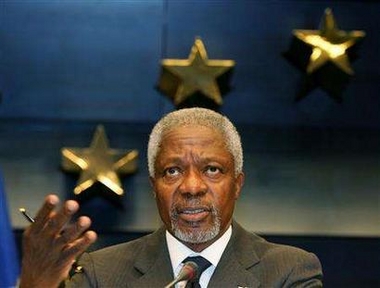
U.N. Secretary-General
Kofi Annan presents a news conference at the end of an emergency meeting
of EU foreign ministers in Brussels August 25, 2006. Annan will discuss
the deployment and role of a planned 15,000-strong peacekeeping force for
southern Lebanon when he visits Beirut on Monday for the first time since
the Israel-Hizbollah war.[Reuters] |
Other issues are likely to include the lifting of an Israeli air and sea
blockade of Lebanon, policing of the Lebanese-Syrian border to stop arms
smuggling and a possible prisoner swap between Israel and the Lebanese Hizbollah
guerrilla group.
Annan, due to meet Prime Minister Fouad Siniora and the speaker of the
Lebanese parliament Nabih Berri, was seeking full implementation of U.N.
Security Council resolution 1701, a U.N. spokesman said at the weekend.
The resolution ended a 34-day war between Israel and Hizbollah on August 14
but also made a series of demands on Israel, Lebanon and the international
community which have yet to be met.
It urged the reopening of Lebanon's airports and harbours, blockaded by
Israel since the start of the war, and the securing of Lebanon's land borders to
prevent arms smuggling.
The resolution also called for the international community to provide enough
troops to allow the United Nations to boost the size of its current UNIFIL force
in Lebanon from 2,000 to 15,000.
Annan discussed the European Union contribution to the expanded force with EU
leaders in Brussels on Friday. He said France, which has promised 2,000 troops,
would lead it until February when Italy, which has pledged 3,000, would take
over.
"We should deploy, I hope, within the next few days, not the next few weeks,"
Annan said after the talks.
A close aide to Siniora said Annan would brief the prime minister on the
Brussels talks.
"But the government will press him first to pressure Israel to end its
blockade on Lebanon because it violates Security Council resolution 1701 and
threatens stability in Lebanon," the aide told Reuters, speaking on condition of
anonymity.
WEAPONS
Israel says until the expanded UNIFIL force arrives to police southern
Lebanon, the blockade is essential to prevent weapons reaching Hizbollah. Since
the end of the war it has relaxed the blockade, allowing commercial planes to
fly in and out of Beirut through Amman in Jordan.
The Jewish state wants U.N. troops to police the 375 km (233 miles)
Lebanese-Syrian border to prevent the smuggling of arms to Hizbollah, but Syria
has said such a move would be hostile and has threatened to close the border if
it happens.
That would effectively cut Lebanon off from the outside world as the
country's only other land border is with Israel, with which it has no diplomatic
ties.
Resolution 1701 does not specifically call for the deployment of U.N. troops
to the Lebanese-Syrian border but asks UNIFIL to assist the Lebanese government
"at its request" in securing the country's borders.
Also expected to be discussed is the release of Israeli and Hizbollah
prisoners, including two Israeli soldiers whose seizure by the Shi'ite Muslim
group on July 12 sparked the war.
Hizbollah wants to exchange them for some of the thousands of Arab prisoners,
including Lebanese, in Israeli jails.
Annan has said both sides will have to make "painful compromises" to get what
they want.
Hizbollah leader Sayyed Hassan Nasrallah said on Sunday contacts had been
made that might eventually lead to negotiations over prisoners.
"It seems that Italy is trying to get into the subject. The United Nations is
interested and the negotiations would be through Berri," Nasrallah said in a
television interview.
An Israeli official said on Sunday: "There are no negotiations over the
exchange of prisoners."
As well as visiting Beirut, Annan is expected to travel to southern Lebanon.
He will go to Israel on Tuesday and is also due to visit Syria and Iran as part
of his Middle East tour.
