Top News
Rumsfeld cautions on missile shield
(AP)
Updated: 2006-08-28 08:56
 |
Large Medium Small |
FORT GREELY, Alaska - After his first look inside the nerve center of the U.S. missile defense system, Defense Secretary Donald H. Rumsfeld on Sunday sounded a note of caution about expectations that interceptors poised in underground silos would work in the event of a missile attack by North Korea.
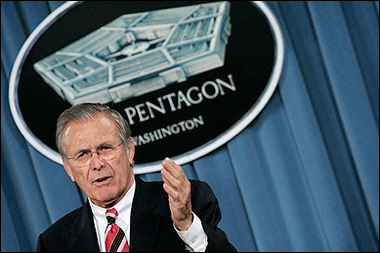 President George W. Bush expressed confidence in embattled US Defense Secretary Donald Rumsfeld, seen here 11 April 2006, despite five retired generals calling for his resignation, blaming his arrogant leadership for critical mistakes in Iraq. [AFP/file] |
Rumsfeld climbed down a steel ladder into one of 10 silos that house single 54-foot-long missile interceptors. If ordered by President Bush, or a successor, one or more of the rockets would blast into the sky and race at more than 18,000 mph to launch a small "kill vehicle" at an enemy warhead as it soared through space.
An 11th interceptor is to be installed at Greely on Monday, officials said.
Asked at a news conference later whether he believed the missile shield was ready for use against a North Korean missile like the one test-fired unsuccessfully on July 4, Rumsfeld said he would not be fully persuaded until the multibillion dollar defense system has undergone more complete and realistic testing.
He alluded to his own skeptical nature. "I want to see it happen," he said, "A full end-to-end" demonstration is needed "where we actually put all the pieces" of the highly complex and far-flung missile defense system together and see whether it would succeed in destroying a warhead in flight.
"That just hasn't happened," he said, adding that some elements of the missile defense system are yet to come on line, including some of the radars and other sensors used to track the target missile.
He declined to say when he thought the missile defense system would reach the point of full reliability, but stressed that his advisers, including Lt. Gen. Henry Obering, the Pentagon's missile defense chief, have told him they believe it will work as designed in the event of an actual missile attack.
"I have a lot of confidence in these folks, and I have a lot of confidence in the work that's been done," Rumsfeld said.
Later, in nearby Fairbanks, Rumsfeld met with his Russian counterpart, Sergei Ivanov. They discussed the situation in the Middle East and in Afghanistan as well as Russian concern about an announced U.S. plan to remove nuclear warheads from some Trident long-range missiles aboard submarines and replace them with conventional warheads for potential use on short notice against terrorist targets.
"I would like to stress this point: These are preliminary (U.S.) plans and for sure these plans raise Russian concern," Ivanov said during a joint news conference with Rumsfeld at a lodge on the banks of the Chena River. "There can be different solutions" to the problem, such as using cruise missiles in that role, he added.
Brig. Gen. Patrick O'Reilly, program director for the ground-based interceptor system, told Rumsfeld that on Thursday an interceptor based at a second launch site, at Vandenberg Air Force Base, Calif., is scheduled to be tested against a target missile launched into the Pacific from Alaska's Kodiak Island.
That will be the first full-up test of the latest version of the interceptor and its "kill vehicle," a device attached to the nose of the interceptor. Once it separates from the interceptor's three-stage booster, the "kill vehicle" is designed to use its own propulsion system and optical sensors to lock onto its target and, by ramming into it at high speed, obliterate the warhead and any payload it might carry.
Thursday's test also will be the first use of an early-warning radar at Beale Air Force Base, Calif., to provide the data required to put the interceptor on a proper path toward its target. The interceptor will be controlled from a command center near Colorado Springs, Colo. Fort Greely has a similar command center.
Obering said the main objective of Thursday's test will be to see if the optical sensors on the "kill vehicle" aboard the interceptor work as designed. Whether it actually intercepts the target is secondary, he said. A further test, now scheduled for December, will try for an intercept, Obering said.
At a news conference, Rumsfeld said that North Korea's leaders showed, by their test-launch of multiple missiles on July 4, a determination to "continue to improve their capability and to threaten and attempt to blackmail other people." He said they also are a threat to spread missile technology to terrorists.
"I think the real threat that North Korea poses in the immediate future is more one of proliferation than a danger to South Korea," he said. Asked to elaborate on that point, Rumsfeld said U.S. intelligence about the intentions of North Korean leaders is not very good, but he said it is clear that the overall condition of the North Korean military has deteriorated. He mentioned that North Korean air force pilots are able to fly fewer than 50 hours a year — less than one-quarter the training done by U.S. pilots.
"I don't see them, frankly, as an immediate military threat to South Korea," he said.