VIENNA, Austria - Germany said Thursday that Iran's response to a package of
incentives to halt its nuclear program was unsatisfactory because of its refusal
to freeze uranium enrichment, and diplomats suggested Tehran now faces a greater
risk of U.N. sanctions.
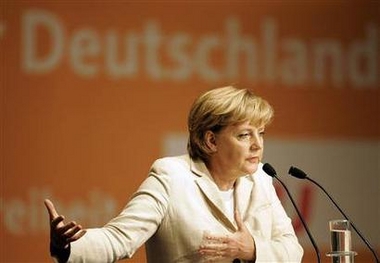
German Chancellor
Angela Merkel delivers a speech in Berlin, August 22, 2006. Iran's
response to an international package of incentives meant to persuade it to
give up uranium enrichment is not satisfactory, German Chancellor Angela
Merkel said in a television interview on Thursday.
[Reuters] |
Two senior diplomats who were briefed on the Iranian response told The
Associated Press that world powers would likely reject it.
The U.N. Security Council has set a deadline of next Thursday for Iran to
freeze enrichment, a possible pathway to nuclear arms and the six nations
offering to talk to Iran say such a step must precede the start of any
discussions.
But the diplomats said the 25-page document does not directly suggest an
enrichment moratorium even after negotiations start.
Instead, it includes only a vague reference to a willingness to discuss all
aspects of the country's nuclear program, said the diplomats who spoke from two
European capitals and asked for anonymity because they were not authorized to
discuss the confidential proposal.
They said the reaction among the six powers - France, Germany, Britain,
Russia, the United States and China was one of disappointment and even anger
that Tehran would not consider a suspension of uranium enrichment as a
precondition for any new talks.
A day after the U.S. administration issued a guarded assessment of Iran's
long-awaited response, German Chancellor Angela Merkel on Thursday said it was
unsatisfactory, and was missing a "decisive sentence" on whether it would halt
uranium enrichment.
"We are still examining it, but from everything that I hear we cannot be
satisfied," Merkel said in an interview with N24 television. "What we expected
is not set down here: 'We are suspending our uranium enrichment, we are coming
to the negotiating table and we will then talk about the chances and
possibilities for Iran.'"
The comments by Merkel, a close ally of President Bush, reflect the
increasing frustration of the United States and its key European allies who have
been forced to wait for several weeks for an Iranian response.
White House spokeswoman Dana Perino said Bush spoke Thursday with Merkel and
Italian Prime Minister Romano Prodi about Iran, but Perino would not say whether
the leaders were of the same mind about what should be done next.
The U.S. State Department has said that Iran considered its proposal to be a
serious one and promised to review it, as did the five other nations that
offered political and economic rewards to Tehran July 1 if it agreed to a freeze
enrichment.
But the diplomats suggested that despite assurances of a serious review, the
capitals involved found little of substance in the document.
One of them said that much of the Iranian response, delivered Tuesday,
confines itself to "a history of Iran's nuclear program from Tehran's point of
view," including arguments that enrichment was its right under the Nuclear
Nonproliferation Treaty.
In it, Iran also asks for more information on various elements of the July 1
offer, including hints that Tehran's cooperation could lead to bolstered
security for the country and the possibility that some or all U.S. sanctions
might be lifted if there is agreement, said one of the diplomats.
One of the diplomats told AP that the lack of Iranian flexibility on
enrichment would likely leave even Russia and China no choice but to ultimately
endorse U.N. sanctions against Iran. Moscow and Beijing previously have steadily
put the brakes on U.S-backed efforts to punish Tehran quickly but have
stipulated that Iran must freeze enrichment.
Iran maintains it has offered "positive and clear signals" to resolve the
dispute over its nuclear program.
Although neither Iran nor its six interlocutors have released the text of
Tehran's counteroffer, two well-informed Iranian academics said it included
about 100 questions, including a request for a timetable for the West to
implement its incentives package.
Abbas Maleki, director of the International Institute For Caspian Studies in
Tehran, and Kevah Afrasiabi, an author and political scientist, made the
statement Thursday in a report distributed by Agence Global.
The two also said that Iran's chief nuclear negotiator, Ali Larijani, had
declared Iran's willingness to use its influence in Lebanon for an exchange of
prisoners held by Hezbollah and Israel, "reminding the world of Iran's
stabilizing role."
French Foreign Minister Philippe Douste-Blazy said Wednesday that Iran must
suspend uranium enrichment if it wants to return to negotiations.
And the U.S. statement issued Wednesday went on to say that Iran's response
to a joint offer of U.S, and European trade and other benefits if the enrichment
program was halted "falls short of the conditions set by the Security Council"
full and verifiable suspension of all uranium-enrichment activity.
Others are urging patience in dealing with Iran. Russia's foreign ministry
said it would continue to seek a negotiated solution, and China appealed for
patience and more dialogue.
The Security Council resolution gives Iran until next Thursday to suspend
enrichment. The Vienna-based International Atomic Energy Agency then will report
on the state of the program by mid-September. If IAEA chief Mohamed ElBaradei's
report finds that enrichment is continuing, as expected, the council is then
likely to move toward economic and political sanctions.
