WASHINGTON - The Bush administration said Wednesday a proposal by Iran for
nuclear negotiations falls short of UN demands that it cease uranium enrichment,
and the US began plotting unspecified "next moves" with other governments.
Those could include UN sanctions against Iran unless it reverses course and
agrees to a verifiable halt to enrichment activities that can be central to
making nuclear weapons.
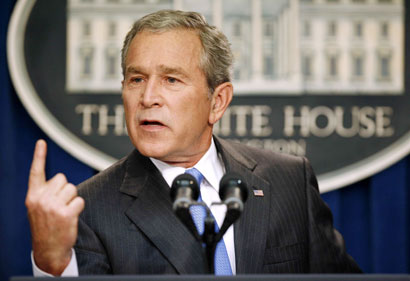
US President George W.
Bush speaks at a news conference at the new briefing room at the White
House Conference Center, across Pennsylvania Avenue from the White House,
in Washington August 21, 2006.
[Reuters] |
The State Department, in a
terse statement, acknowledged that Iran considered its proposal to be a serious
one. "We will review it," the statement said in what appeared to be a
conciliatory gesture to a government it regularly denounces as a sponsor of
terror.
But the statement went on to say that Iran's response to a joint offer of US
and European trade and other benefits if the enrichment program was halted
"falls short of the conditions set by the Security Council" -- full and
verifiable suspension of all uranium-enrichment activity.
"We are consulting closely, including with other members of the Security
Council, on next steps," it said. The United Nations has set a deadline of next
Thursday for a formal reply by Tehran.
US President Bush met with Secretary of State Condoleezza Rice at the White
House and then discussed Iran's proposal in a telephone call with UN
Secretary-General Kofi Annan.
The call was initiated by Annan, White House spokeswoman Dana Perino said.
The administration has cautioned Iran that it will seek sanctions in the
Security Council if Tehran does not step enriching uranium.
Administration officials have refrained from outlining what punishment they
might have in mind. It could include economic or political penalties, perhaps
international curbs on trade.
Rice, meanwhile, telephoned Javier Solana, the senior European Union diplomat
who oversees exchanges with Iran. No account of their conversation, nor of her
meeting with the president, was provided.
By not rejecting Iran's proposal outright, the administration indicated there
may be a basis for dealing with long-held concerns that Tehran is developing
nuclear weapons, an allegation the Iranians deny.
"The diplomats are continuing to look at it," Perino said. "We're working
with our allies."
France took a firm and quick stand. Foreign Minister Philippe Douste-Blazy
said Iran must suspend uranium enrichment if it wants to return to negotiations.
Russia's foreign ministry, evidently ambivalent, said it would continue to
seek a negotiated solution. And China appealed for dialogue, urging
"constructive measures" by Iran and patience from the United States and its
allies.
Iran met its self-imposed deadline Tuesday for responding to the US-European
offer, which includes the possibility of U.S. help for civilian nuclear programs
-- but only if Iran stops uranium enrichment.
On Capitol Hill, meanwhile, the House Intelligence Committee issued a report
that concluded Iran was a strategic threat and a country focused on developing
nuclear weapons capability. It also linked Iran to Hezbollah, Hamas and other
terrorist groups.
"Iran's support of radical Islamists with weapons and money demonstrates in
real terms the danger it poses to America and our allies," said the committee's
chairman, Rep. Peter Hoekstra, R-Mich. He said Iran "will not be satisfied until
it poses a threat to the entire world."
The report also said there are gaps in the ability of US intelligence
agencies to keep up with developments in Iran's nuclear program and suggested
hiring more intelligence agents who speak Farsi.
