BEIRUT, Lebanon - Syria on Wednesday opposed deployment of an international
force along its border to prevent arms shipments to Hezbollah, and Israel called
the situation in Lebanon "explosive." A cease-fire was further shaken by
artillery shells and explosions that killed three Lebanese soldiers and an
Israeli.
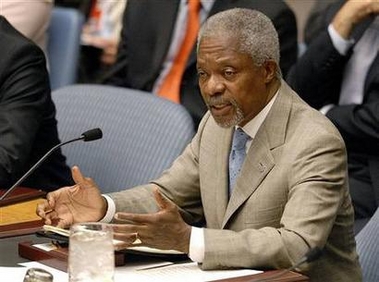
U.N. Secretary General
Kofi Annan speaks at the United Nations in New York, August 11, 2006.
Annan plans to visit Israel, Lebanon, Iran and Syria in coming days to
help shore up an uneasy Lebanon cease-fire, the United Nations announced
on Wednesday. [Reuters] |
Lebanese Prime Minister Fuad Saniora asked the U.S. to help lift an Israeli
blockade on his country's coast and airport, something Israeli Prime Minister
Ehud Olmert said would not happen until U.N. troops deployed along the
Lebanon-Syria border to block the flow of weapons. Hezbollah's vast arsenal of
rockets and other weapons, much of which is believed to originate in Iran,
reaches the guerrillas across the Syrian border.
European Union ambassadors and deputies met in Brussels, Belgium, to drum up
volunteers for the force, but tentative pledges reached just 4,200 troops by
Wednesday, far short of the 15,000 called for by the U.N. cease-fire resolution.
Deployment was likely take weeks or months.
Meanwhile, Syria indicated it might impose a blockade of its own.
"They will close their borders for all traffic in the event that U.N. troops
are deployed along the Lebanon-Syria border," Finland's foreign minister Erkki
Tuomioja said after meeting his Syrian counterpart, Walid Moallem, in Helsinki.
Finland holds the rotating presidency of the European Union.
Lebanon has land borders only with Syria and Israel.
Syria's threat to close its border and Israel's resolve to continue the
blockade were among the burgeoning hurdles facing Lebanon as it struggled to
meet key requirements of the U.N. resolution: deployment of 15,000 Lebanese
soldiers south for the first time in four decades and stiffening control on all
borders.
Saniora said his government was making "every effort" to secure the borders,
but Israeli Foreign Minister Tzipi Livni questioned the pace.
"Time is working against those who would like to see this resolution
applied," Livni told reporters after talks in Paris with French Foreign Minister
Philippe Douste-Blazy. "We are now in the most sensitive and explosive
position."
Several incidents erupted along the Israel-Lebanon border Wednesday, with the
killing of three Lebanese and one Israeli soldier by exploding ordnance, the
capture of two Lebanese men in an army raid, and the resumption of sporadic
shelling by Israeli forces in the disputed Chebaa Farms.
Olmert told Secretary of State Condoleezza Rice by phone that the
international force must arrive as soon as possible, so the sea and air blockade
could be called off, his office said.
Syria, a Hezbollah benefactor largely left out of diplomacy during the 34-day
war appeared to insert itself Wednesday.
Syrian President Bashar Assad called any deployment of multinational troops
along his border a "hostile" affront to Syria.
| 1 | 2 |  |
