JERUSALEM - Prime Minister Ehud Olmert said Tuesday that Israel has no plans
to lift its air and sea blockade of Lebanon takes up positions along the Syrian
border and at Beirut's airport.
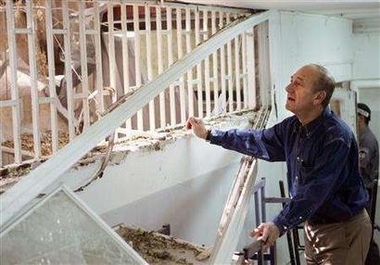
Israel's Prime
Minister Ehud Olmert inspects a classroom hit by a Hizbollah rocket at a
school building in the northern Israeli town of Kiryat Shmona, August 21,
2006.[Reuters] |
Israeli officials said Olmert wasn't issuing an ultimatum. But the tough
stance appeared to be an attempt to put pressure on the international community
to send a powerful force willing to disarm Hezbollah, which fired thousands of
rockets into northern Israel during 34 days of fighting.
Olmert laid down his position in a meeting with U.N. envoy Terje Roed-Larsen,
who is in the region to discuss implementation of a U.N.-brokered cease-fire
that ended the war between Israel and Hezbollah. Diplomats are still trying to
hammer out final details, including the peacekeeping force's precise
responsibilities.
"Olmert said deploying the force at border crossings to Syria and at the
airport will allow the lifting of Israel's sea and air closure and contribute to
the implementation" of the cease-fire, the prime minister's office said.
Roed-Larsen said the security situation in Lebanon would remain "vulnerable"
for the next two or three months, but said Lebanon was working to secure its
borders. He said he hopes the embargo will be lifted soon.
An Aug. 11 Security Council resolution calls for a 15,000-member
international force to monitor Lebanon's southern border with Israel and help
the Lebanese army assert authority throughout the country.
While the resolution does not explicitly call on the force to police the
Syrian frontier, it says it should help Lebanon secure its borders and prevent
arms from illicitly entering the country.
Israel says Syria is a main supplier of weapons to Hezbollah, and officials
said Israel was seeking assurances that arms do not reach the group again. The
cease-fire resolution calls for a halt in arms transfers to the guerrillas, and
a 2004 resolution requires the group to disarm.
"The disarmament of Hezbollah is our main objective. As long as it is not
disarmed, we will defend ourselves against their being rearmed," said Miri
Eisin, a senior Israeli government official. "To do so, we're going to stop all
of the routes that allow the supplies to arrive to Hezbollah - sea, air and
land."
Israel imposed the blockade shortly after the outbreak of fighting on July
12. Since the cease-fire took hold, air traffic has largely been limited to aid
flights and official delegations, while shipping is limited to relief efforts
and vessels with prior authorization.
Lebanese Labor Minister Tarrad Hamadeh, a member of Hezbollah, said Tuesday
that Lebanon may ask Arab ships and airlines to break the Israeli blockade, a
move that could lead to a broader conflict. Lebanese officials from rival
factions have also criticized the blockage.
"If Israel wants to attack, let them attack Arab ships and planes and let
them shoulder the responsibility before the international community," Hamadeh
said. Arab agreement to a blockade-running attempt was seen as unlikely,
however.
In an interview with The Associated Press, Roed-Larsen said the security
situation in Lebanon would remain "vulnerable" in the coming months as the
Lebanese army deploys in the south along the Israeli border and the beefed-up
U.N. force arrives to help.
"Until the Lebanese force is completely deployed and has asserted its full
authority and until there is a robust peacekeeping force there and the necessary
cooperation is established, there will be, up to a point, a security vacuum," he
said.
He also said Secretary-General Kofi Annan is working relentlessly to find
countries willing to send peacekeepers to Lebanon, but acknowledged the process
was slow. Roed-Larsen said Annan is considering visiting the region himself.
Roed-Larsen was joined by Vijay Nambiar, an adviser to Annan, who said
efforts are continuing to secure the release of two Israelis captured by
Hezbollah. Nambiar hinted that Israel might be warming to the idea of a prisoner
swap ¡ª something it ruled out at the outset of the fighting.
He said the idea had been raised with Israeli counterparts and it "may find
some traction now." The July 12 cross-border kidnapping of the soldiers sparked
the 34-day war.
