TEHRAN, Iran - Iran said Tuesday it was ready for "serious negotiations" on
its nuclear program, offering a new formula to resolve a crisis with the West. A
semiofficial news agency said the government was unwilling to abandon uranium
enrichment - the key US demand.
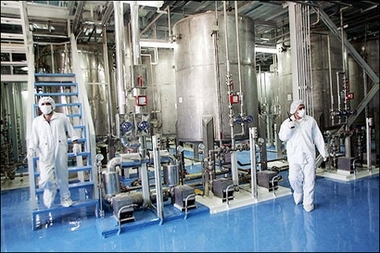
Iranian technicians
are seen at the Isfahan Uranium Conversion Facilities (UCF), 420 kms south
of Tehran, in 2005. Iran called for talks as it delivered its response to
a deal aimed at ending a long-running nuclear standoff but it did not say
whether it had met the demands of the international community.
[AFP\File] |
Iran delivered its written response to a package of incentives offered by the
United States and five other world powers to persuade Iran to roll back on its
nuclear program and punishments if it does not. The world powers, the five
permanent U.N. Security Council members plus Germany, have given Iran until Aug.
31 to accept the package.
The U.S. ambassador to the United Nations, John Bolton, said Washington will
"study the Iranian response carefully" but was prepared to move forward with
sanctions against Tehran if it was not positive. The White House held off
commenting until it had studied the text. The European Union's foreign policy
chief, Javier Solana, said the document was "extensive" and required "a detailed
and careful analysis."
Iranian officials offered no details of the response, but it appeared geared
at enticing those countries into further negotiations by offering a broad set of
proposals vague enough to hold out hope of progress in resolving the standoff.
If the Iranians leave the door open to halting enrichment as talks progress,
that would drive a wedge in the Security Council between the Americans, British
and French on one side and the Russians and Chinese on the other. Last month,
Russia said the Council was in no rush to pressure Iran, striking a more
conciliatory tone than the United States.
Tuesday's announcement was the latest development in the yearlong standoff
over Tehran's nuclear program. Iran says it wants to master the technology to
generate nuclear power. But critics say Iran is interested in uranium enrichment
because it can also be used to make the fissile core of nuclear weapons.
The current drama is playing out in the wake of fears that the ability of the
pro-Iranian Hezbollah guerrillas in Lebanon to withstand 34 days of Israeli
bombardment has emboldened hard-liners in Tehran to risk a showdown with the
Americans, who are bogged down in neighboring Iraq. There has also been
speculation in the West that Iran encouraged Hezbollah to provoke the Israelis
to distract attention from its nuclear ambitions.
Iran has pursued a confrontational stance on the nuclear issue since the
election of President Mahmoud Ahmadinejad last year. The hard-line president has
used the nuclear issue to encourage a sense of national pride among Iranians by
standing up to the United States and other Western countries.
On Tuesday, Iran's top nuclear negotiator, Ali Larijani, hand-delivered his
government's response to ambassadors of Britain, China, Russia, France, Germany
and Switzerland, which represents U.S. interests - nine days before a Security
Council deadline for Iran to halt uranium enrichment or face economic and
political sanctions.
Larijani refused to disclose whether the response included an offer to
suspend uranium enrichment. But the semiofficial Fars news agency reported that
Iran rejected calls to suspend "nuclear activities" or uranium enrichment and
"instead has offered a new formula to resolve the issues through dialogue."
The state-run television quoted Larijani as telling the diplomats Iran "is
prepared as of Aug. 23rd (Wednesday) to enter serious negotiations" with the
countries that proposed the incentives package.
The Irna official news agency reported that "Larijani said Iran's answer has
logically, fairly and constructively addressed demands of the proposed package,
recommending the P5+1 group to return to the negotiation table immediately
despite the false atmosphere created against Iran that it was buying time."
Last month, the Security Council set an Aug. 31 deadline for Iran to halt
uranium enrichment or face economic and political sanctions. Iran called the
resolution "illegal" but had said it was willing to offer a "multifaceted
response" to an incentives package that the six powers offered in June.
Iranian officials familiar with Larijani's response said Tehran offered a
"new formula" to resolve the dispute. The officials spoke on condition of
anonymity because of the sensitivity of the information.
"Iran has provided a comprehensive response to everything said in the Western
package. In addition, Iran, in its formal response, has asked some questions to
be answered," one official said without providing more details.
But the Iranians have been signaling they are not prepared to abandon uranium
enrichment as a precondition to talks. Last month, a senior Iranian lawmaker
said the country's parliament was preparing to debate withdrawal from the
Nuclear Nonproliferation Treaty if the U.N. Security Council adopts a resolution
to force Tehran to suspend enrichment.
On Monday, Iran's supreme leader, Ayatollah Ali Khamenei, said the Islamic
Republic "has made its own decision and in the nuclear case, God willing, with
patience and power, will continue its path." Khamenei accused the United States
of putting pressure on Iran despite Tehran's assertions that its nuclear program
was peaceful.
Iran's former foreign minister Ali Akbar Velayati, who is now a top adviser
to Khamenei, said Iran's national interests, not the West's demands, should be
the basis for Iran's decision.
"What we have achieved in nuclear technology is worth more than the pressures
against us at the international stage," the semiofficial Iranian Students News
Agency quoted Velayati as saying Tuesday.
In February, Iran for the first time produced its first batch of low-enriched
uranium, using a cascade of 164 centrifuges.
In the last few weeks, Iran prevented U.N. nuclear agency inspectors from
inspecting an underground site meant to shelter its uranium enrichment program
from attack, diplomats said Monday.
The head of the International Atomic Energy Agency, Mohamed ElBaradei, is to
report by Sept. 11 to the agency's board on Iran's compliance with the U.N.
deadline to freeze enrichment and other aspects of Tehran's cooperation with
U.N. inspectors.
The Western incentives package has not been made public but some details have
leaked. They include an offer to lift a ban on sales of Boeing passenger
aircraft, providing Iran with some nuclear technology to build reactors for
civilian purposes and guaranteeing a supply of nuclear fuel.
