TEHRAN - Iran is due to give its reply on
Tuesday to a package backed by six world powers that aims to end a nuclear
standoff with the West, but Iranian officials say Iran does not accept the key
demand to suspend uranium enrichment.
Western diplomats say refusing to suspend the work that has both military and
civilian uses would be tantamount to rejecting the package of incentives offered
in return.
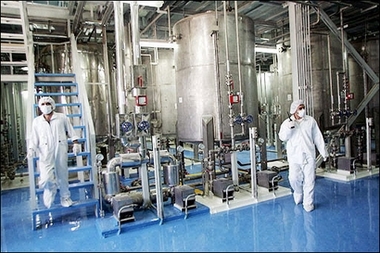
File picture of
Iranian technicians at the Isfahan Uranium Conversion Facilities (UCF),
420 kms south of Tehran, August 2005. Iran's supreme leader has said the
country would press on with its controversial nuclear work, paving the way
for a likely showdown with the UN Security Council despite appeals for
Tehran to bow to international demands.[AFP] |
But refusal will not yet trigger action by the U.N. Security Council, which
passed a resolution last month giving Iran until August 31 to halt enrichment or
face possible sanctions.
"We are not treating (Tuesday) as a deadline because it is not the Security
Council deadline," one Western diplomat said, but added: "If Iran flatly refuses
to suspend enrichment, then there will, fairly soon, be more talks in the
Security Council."
The United States, France, Britain, Germany, China and Russia offered a
package of economic and other incentives in June, aiming to goad the Islamic
Republic into stopping work that the West says is being used to build nuclear
warheads.
Iran said it would reply by the end of the Iranian month of Mordad, August
22, but the world's fourth largest oil exporter insists it will not abandon what
it calls its right to enrich uranium for use in nuclear power stations.
Supreme Leader Ayatollah Ali Khamenei, who has the final word in Iran, vowed
on Monday that Iran would not be deflected from its pursuit of nuclear energy.
President Mahmoud Ahmadinejad has also been a vociferous opponent of compromise.
Other Iranian officials have stated plainly that Iran will not stop
enrichment.
DIVISIONS
Iran has not yet said precisely how it will reply. A senior Iranian official
said Iran might give a written response to European ambassadors in Tehran but
said mostly likely Iran will deliver the reply in Brussels to Javier Solana, the
European Union's foreign policy chief who presented the package.
Iran has said its reply will be "multi-dimensional", suggesting no simple
'yes' or 'no'. Officials have also said Iran wants more talks to resolve the
dispute.
Such an approach, say diplomats, could further expose divisions in the
Security Council, where the United States, France and Britain back sanctions but
Russia and China, the other two veto wielding members, have been wary of such a
move.
"If they reject suspension, that's rejection of the package (for Western
capitals)," said one Western diplomat, but added that Russia and China might
take a different view.
"If they said suspension was negotiable, there would be pressure on (the six
powers) to think about it," the diplomat added.
Analysts say Iran is probably calculating any move towards sanctions would
start with modest steps, such as travel bans on officials or asset freezes,
which it can tolerate because the country's coffers are brimming with
petrodollars.
U.S. President George W. Bush said on Monday the international community
should "work in concert" over Iran. Washington has previously warned of swift
U.N. action if Iran fails to meet U.N. demands.
United States says it wants a diplomatic solution to the standoff, but has
also refused to rule out military action.
U.S. investigative journalist Seymour Hersh wrote this month that Washington
believed Israel's conflict with Hizbollah could serve as a possible prelude to
potential U.S. strikes on Iran's nuclear sites.
