LONDON - Police found martyrdom videos and bomb-making components during the
investigation of the alleged plot to blow up U.S.-bound jetliners, prosecutors
said Monday in announcing 11 people had been charged with terrorism offenses.
Officials confirmed for the first time that the plot involved the manufacture
of explosives, which were to be used to assemble and detonate bombs inside as
many as 10 airliners. U.S. officials previously had said the plot appeared to
involve mixing liquid-based chemicals to make explosives aboard the aircrafts.
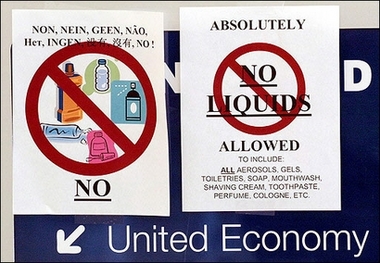
Signs indicating no
liquids allowed in carry-on baggage for airline travellers are posted at
the United Airlines terminal at JFK International Airport in New York.
Canada will re-authorize the sale of liquid items at airport duty free
shops, lifting a suspension imposed after British authorities foiled an
alleged airline bombing plot, authorities
said.[AFP\File] |
One woman was released from custody Monday and police continued to
interrogate 11 others who remain "under active investigation," lead prosecutor
Susan Hemming said.
Those charged were scheduled to appear in court Tuesday morning, but because
of the seriousness of the accusations, it was unlikely bail would be granted.
The briefing by police and prosecutors lasted less than eight minutes, but
provided more information than had been released in the 11 days since the
alleged plot was first disclosed and air travel out of Britain was thrown into
turmoil.
They said investigators had found bomb-making materials ¡ª including hydrogen
peroxide and electrical components ¡ª and seized more than 400 computers and 200
cell phones in nearly 70 searches.
More than 8,000 items used for data storage, such as compact discs, DVDs and
memory sticks, were reported found. Maps of Afghanistan, suicide notes from
willing terrorists and books on explosives also were seized, officials said.
"We have also found a number of video recordings ¡ª these are sometimes
referred to as martyrdom videos," said Assistant Deputy Commissioner Peter
Clarke, who heads the Metropolitan Police's anti-terrorism unit. "This has all
given us a clearer picture of the alleged plot."
According to dates given by prosecutors, the plot could have begun last year.
The details of the charges against one man, Mehran Hussein, allege he had
information that could have prevented a terrorist act and didn't disclose it
sometime between Sept. 23, 2005, and Aug. 10, 2006 ¡ª the day police announced
breaking up the plot.
In all, eight people were charged with conspiracy to commit murder and
preparing acts of terrorism. One person, a 17-year-old, was charged with
possession of articles that could be used to prepare a terrorist act and two
people were charged with failing to disclose information that could help prevent
a terrorist act.
Nine of those charged were from London, according to a Bank of England list
of suspects whose assets were frozen following the arrests. Two were from High
Wycombe, 30 miles northwest of London.
The briefing was also a chance for police to show they were avoiding missteps
in previous terror investigations that had arroused considerable public
skepticism over their actions. Clarke did not mention two earlier events but
pledged that investigators would be diligent.
In June, two brothers were detained in a raid by London police looking for a
chemical bomb. One of the men was shot and wounded. No explosives were found and
the brothers were released. The incident caused anger in London's Muslim
community.
Last year, police killed a Brazilian bystander aboard a subway train after
officers mistook him for a suicide bomber following the July 7 bombings that
killed 52 people.
Officials at the briefing did not mention links between the alleged plotters
and any particular group, and reporters were not allowed to ask questions.
Pakistani authorities have linked several people arrested there in the
alleged bomb conspiracy to al-Qaida militants both in Pakistan and in
neighboring Afghanistan, where Islamic militants are fighting the U.S.-backed
government.
Among those being interrogated in Pakistan is Rashid Rauf, a Briton of
Pakistani descent who officials in the South Asian nation say played a key role
in the plot. His brother, Tayib, who was videotaped at a grocery story in
Birmingham just hours before he was arrested Aug. 10, was not among those
charged.
British investigators have until Wednesday to decide how to proceed with the
11 people still held without charges. Police could file charges, release them or
ask a judge to grant more time for questioning.
Police said the investigation was "far from complete," saying it would
continue for months.
"All the data will be analyzed," Clarke said. "There will be thousands of
forensic examinations and comparisons. Fingerprints, DNA, electronic data,
handwriting comparisons, chemical analysis and indeed the full range of forensic
disciplines will be used."
After British officials announced they had foiled the alleged plot, tighter
security was immediately imposed at airports around the world. Passengers were
banned from carrying hand luggage and liquids onto planes.
Britain's air transportation network, in particular, was plunged into chaos,
with long lines jamming airport terminals and many airline flights canceled. By
Sunday, airport officials said the situation was busy but had begun to return to
normal.
