BEIRUT - Italian Prime Minister Romano Prodi said on Monday his country was
ready to lead a U.N. force in southern Lebanon, where the fragility of a
week-old truce was underlined when Israeli forces fired at Hizbollah guerrillas.
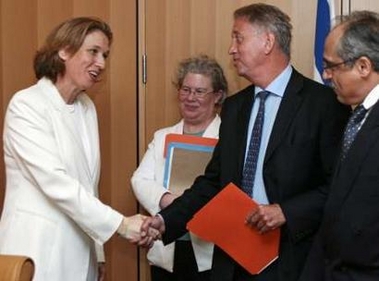
Israel's Foreign
Minister Tzipi Livni (L) shakes hands with United Nations envoy Terje
Roed-Larsen (2nd R) during their meeting in Jerusalem August 21, 2006. A
truce between Israel and Hizbollah guerrillas entered its second week on
Monday as Italy emerged as potential leader of a beefed-up U.N. force
charged with helping keep the peace in southern
Lebanon.[Reuters] |
"I confirmed the Italian willingness (to U.N. Secretary-General Kofi Annan),"
Prodi told reporters, adding that Annan would make a final decision on the
command of the force this weekend.
The Lebanese government welcomed Italy's offer of 2,000 troops, the biggest
commitment any country has made yet. Israel has already said it would be happy
if Italy led the force.
Italy's right-wing opposition warned the deployment could prove a "kamikaze"
mission.
President Bush called earlier for the urgent dispatch of U.N. peacekeepers to
south Lebanon to help enforce the truce, which halted 34 days of fighting in
which nearly 1,200 people in Lebanon and 157 Israelis were killed.
Turkey, Spain and other countries are still hesitating over whether to send
contingents after France, previously tipped to lead the force, sharply reduced
its anticipated contribution.
"The international community must now designate the leadership of this
international force, give it robust rules of engagement and deploy it as quickly
as possible to secure the peace," Bush told a news conference in Washington.
Bush also announced a $230 million aid package to Lebanon that includes
25,000 tonnes of wheat.
In a sign of the truce's shakiness, Israel said its troops shot and wounded
three Hizbollah guerrillas in southern Lebanon. It said the guerrillas had been
approaching the Israeli troops in a "threatening way."
The U.N.-brokered truce has already been jolted by an Israeli commando raid
in eastern Lebanon's Bekaa Valley on Saturday that the United Nations described
as a violation.
The U.S. ambassador to the United Nations, John Bolton, said the United
States wanted a new U.N. Security Council resolution on disarming Hizbollah but
that this should not hold up the quick dispatch of U.N. troops to Lebanon.
The United Nations has vowed to move 3,500 extra troops to the south by
September 2 but has received few firm offers of help to build the force to its
authorized strength of 15,000.
Bolton said countries wanted to be sure troops would have the maximum
authority to defend themselves. "That is one of the reasons why we and others
sought a very robust mandate for the force, and why this may still remain to be
worked out," he said.
France had been expected to lead the mission but then dismayed the United
Nations by offering only 200 troops to add to those it already has in the
existing 2,000-strong U.N. peacekeeping mission in Lebanon, a former French
colony.
Bush urged France to increase its contribution. "I would hope that they would
put more troops in," he said. "France has had a very close relationship with
Lebanon."
The Lebanese army has deployed along the Syrian border and has moved deep
into the shattered south, but Israel says its troops will not pull out fully
until extra U.N. forces arrive.
U.N. envoy Terje Roed-Larsen said after talks with Israeli Foreign Minister
Tzipi Livni and senior Olmert aides he hoped Israel would end its air and sea
blockade of Lebanon as Lebanese authorities take full control of the borders.
He said he saw "reason for optimism" that all parties would fully respect the
truce.
The Israeli government came under further fire at home for its handling of
the war, which failed to destroy Hizbollah or secure the release of two soldiers
whose capture by Hizbollah in a cross-border raid on July 12 sparked the
conflict.
Israeli reservists vented their anger at politicians and army officers for
indecisiveness and other perceived failures.
"The government didn't take seriously the lives of our troops," said Zvi
Marek, a reserve infantry soldier at a demonstration in Jerusalem.
In addition, Israeli Brigadier-General Yossi Heiman said the military had
been guilty of arrogance in its approach.
In a sign that life is gradually returning to normal in Beirut, the Lebanese
stock exchange lifted restrictions brought in during the war to limit price
volatility. Trade was brisk and the benchmark BLOM Stock Index rose 5.8 percent.
The emir of Qatar, Sheikh Hamad bin Khalifa al-Thani, became the first head
of state to visit Lebanon since the war. Lebanese officials have said Qatar has
offered to rebuild devastated villages in the south.
