JERUSALEM - Prime Minister Ehud Olmert has put his proposal for an Israeli
pullout from parts of the occupied West Bank on hold for now following the war
in Lebanon, an Israeli newspaper reported on Friday.
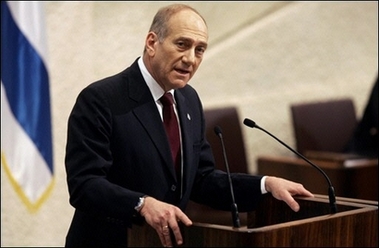
Israeli Prime Minister
Ehud Olmert speaks in front of the Knesset (Israeli parliament) in
Jerusalem on 14 August 2006. Olmert already under fire for his handling of
the Lebanon war, is facing a possible probe over a Jerusalem property
deal. [AFP] |
The Haaretz daily, citing what it said were private conversations between
Olmert and other ministers and party members, quoted the prime minister as
saying the issue was no longer at the top of his government's agenda.
A source in Olmert's office acknowledged that the prime minister's more
pressing priority for now was leading the recovery from economic damage in
northern Israel caused by a month of rocket attacks by Lebanese Hizbollah
guerrillas.
Under the West Bank plan, which had yet to be set in motion, Israel, in the
absence of a Palestinian peace partner, would remove dozens of isolated
settlements and bolster major enclaves it says it intends to keep and set a
border by 2010.
But resurgent violence in Gaza, which Israel evacuated last year, plus the
Lebanon war appear to have dampened the public's enthusiasm for territorial
withdrawals, which Olmert made the centerpiece of his manifesto that won him
election in March.
Rightist opponents of the Gaza pullout had warned it would only embolden
Palestinian militants in their fight against Israel.
Palestinians have remained skeptical of Olmert's "convergence plan," saying
it would deny them a viable state encompassing both the West Bank and Gaza
Strip.
Olmert -- who succeeded Ariel Sharon, comatose since a massive stroke in
January -- was quoted by Haaretz as saying it would not be "appropriate" to
discuss his West Bank proposal at this time.
He told Reuters in an interview earlier this month that it was too soon to
talk about his West Bank plan but that he had no intention of abandoning it
altogether.
At least 1,110 people in Lebanon and 157 Israelis were killed in the 34-day
war that erupted after Hizbollah guerrillas captured two Israeli soldiers in a
cross-border raid on July 12.
Israel responded with air and ground assaults, and Hizbollah fired nearly
4,000 rockets into northern Israel, damaging hundreds of homes and businesses,
before a U.N.-brokered ceasefire took effect on Monday.
Israel's total costs and damages have been estimated at $5.3 billion, Haaretz
said, citing treasury sources.
