BEIRUT, Lebanon - The Israeli army began handing over positions to the U.N.
early Thursday, stepping up its withdrawal from southern Lebanon after the
Lebanese government agreed to deploy troops near Israel's border for the first
time in 40 years.
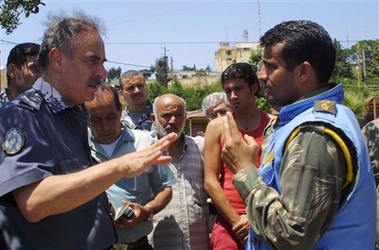
Lebanese Brig. Adnan Daoud, left,
talks to a U.N. peacekeeper in the southern town of Marjayoun, Lebanon, in
this picture taken Friday, Aug. 12, 2006. Daoud was ordered arrested
Wednesday Aug 16 2006 for appearing in a videotape drinking tea with
Israeli soldiers who had occupied his south Lebanon barracks during their
incursion of the country .Lebanese law forbids any dealings with Israel.
[AP] |
The Lebanese Cabinet decision fell short of agreement on disarming the Shiite
Muslim militant group, which has insisted it has the right to defend Lebanese
territory as long as Israeli troops remain in the country.
More than 50 percent of the areas Israel holds has been transferred to the
U.N. peacekeeping force known as UNIFIL, the Israeli army said, adding the
process would occur in stages and would depend on a stronger U.N. force as well
as "the ability of the Lebanese army to take effective control of the area."
The army said it was the first time it handed over territory to the United
Nations, although it had redeployed some of its forces previously.
The Lebanese army has been assembling north of the Litani River, 18 miles
from the Israeli border, and was to cross Thursday morning.
The cease-fire plan calls for the 2,000-member U.N. force to increase to
15,000 and to be joined eventually by an equal number of Lebanese to assume
control as Israeli forces withdraw.
Israeli Foreign Minister Tzipi Livni said completion of the Israeli pullout
depended on the presence of both the Lebanese army and an international force.
She also said she wanted the international force to help monitor the border to
prevent Iran and Syria from replenishing Hezbollah's weapons.
"If there is a place that Israel can withdraw from and the Lebanese army can
come, plus international forces, we'll do it," Livni said after meeting with
U.N. Secretary-General Kofi Annan in New York. "But if it takes time until the
international forces are organized, it takes time until Israel withdraws. This
is the equation."
Israel had as many as 30,000 troops in southern Lebanon during the conflict
that began July 12 when Hezbollah captured two Israeli soldiers in a
cross-border raid. Lt. Gen. Dan Halutz, the Israeli chief of staff, said earlier
that Israeli soldiers would stay in southern Lebanon for months, if necessary.
Despite continued division over disarming Hezbollah, the Cabinet decision to
deploy Lebanese troops was a major step toward meeting demands that the
guerrillas be removed from Israel's northern frontier. It would also mark the
extension of government sovereignty over the whole country for the first time
since 1969, when the Lebanese government sanctioned Palestinian cross-border
attacks on Israel.
The Lebanese government, which includes two Hezbollah ministers, met for the
first time since the cease-fire took hold Monday, after two postponements
because of divisions over Hezbollah's arms. The guerrillas have resisted
pressure to give them up or even withdraw them from the border area.
"There will be no confrontation between the army and brothers in Hezbollah,"
Information Minister Ghazi Aridi said after the Cabinet meeting. "That is not
the army's mission. ... They are not going to chase or, God forbid, exact
revenge (on Hezbollah)."
"There will be no authority or weapons other than those of the state," Aridi
said. "If any weapon is found, even the brothers in Hezbollah have said 'Let it
be in the hands of the army. No problem.' "
The militant group has insisted it has the right to defend Lebanese territory
as long as Israeli troops stay.
Hezbollah's top official in south Lebanon hinted that the guerrillas would
not disarm or withdraw but would keep its weapons out of sight. Hezbollah will
have "no visible military presence," Sheik Nabil Kaouk told reporters in the
southern port city of Tyre.
Hezbollah has used charity work and social welfare programs financed by Iran
to win wide support throughout Lebanon.
It continued that tradition Wednesday, saying it would help tens of thousands
of Lebanese reconstruct homes that were destroyed by Israel, a move likely to
deepen support among Shiites, who make up about 35 percent of Lebanon's 4
million people.
At a Beirut high school, Hezbollah officials took information from hundreds
of people who need money to rebuild. The group's leader, Sheik Hassan Nasrallah,
has promised money for civilians to pay rent and even buy furniture.
The Lebanese death toll, meanwhile, rose to 842 when rescue workers pulled 32
bodies from the rubble in the southern town of Srifa, target of some of Israel's
heaviest bombardment in the 34-day conflict. The figure was assembled from
reports by security and police officials, doctors and civil defense workers,
morgue attendants as well as the military.
The Israeli toll was 157, including 118 soldiers, according to its military
and government.
In a televised address, Prime Minister Fuad Saniora praised Lebanon's
resistance, saying it showed that Israel's military was "no longer a force that
cannot be resisted, an army that cannot be defeated."
He said Lebanon has the right to take charge of its destiny and warned of
foreign meddling that has made the country into a battleground for Israelis,
Palestinians, Syrians and Iranians over the decades.
The government ordered the army to "insure respect" for the Blue Line, the
U.N.-demarcated border between Lebanon and Israel, and "apply the existing laws
with regard to any weapons outside the authority of the Lebanese state."
That provision does not require Hezbollah to give up its arms, but rather
directs them to keep them off the streets.
Foreign diplomats worked to assemble the international force that will
augment the current 2,000-member U.N. peacekeepers, known as UNIFIL, who have
been in the area for more than two decades. The U.N. hopes 3,500 international
troops can reinforce the contingent already on the ground within 10 to 15 days,
Assistant U.N. Secretary-General for Peacekeeping Hedi Annabi said.
French Defense Minister Michele Alliot-Marie said France is willing to lead
the enlarged U.N. force until at least February. But she expressed concern that
the force's mandate was "fuzzy" and said the peacekeepers needed sufficient
resources and a clear mission to avoid a "catastrophe."
The U.N. resolution passed Friday authorized the peacekeepers to use force
"to ensure the movement of aid workers and protect civilians in imminent danger,
among other situations." But France has been demanding a more specific mandate,
including when it may use firepower.
In a sign of lingering danger in south Lebanon, security officials said an
explosive detonated Wednesday in the town of Nabatiyeh, killing 20-year-old man.
A girl in the area was injured by explosives earlier.
Aid officials said unexploded ordnance was forcing relief workers to move
gingerly in evacuating the wounded and in making deliveries of food and fuel.
Lebanese authorities and Hezbollah sent teams across south Lebanon to clear
explosives.
