ON THE ISRAEL-LEBANON BORDER - Hundreds of Israeli soldiers walked out of
Lebanon on Tuesday, some smiling broadly and pumping their fists, others weeping
or carrying wounded comrades as a cease-fire with Hezbollah solidified after a
shaky start. The process was expected to accelerate over the coming days.
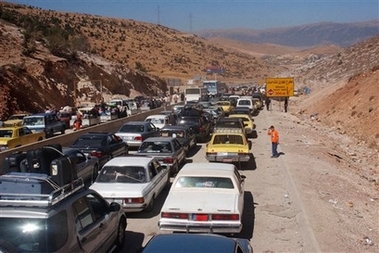
Lebanese displaced
citizens, returning to Lebanon, wait to cross the damaged road between the
Lebanese and the Syrian checkpoints, at the Masnaa crossing, in the
eastern Bekaa Valley, Lebanon, Tuesday, Aug. 15, 2006. Tens of thousands
of Lebanese jammed bomb-cratered roads Tuesday for the second day as they
returned to scenes of destruction after a tenuous cease-fire, which took
hold Monday, ended 34 days of vicious combat between Israel and
Hezbollah.[AP] |
The international community looked to build a U.N. peacekeeping force for
south Lebanon, but it remained unclear how quickly such a force could be
deployed. The guerrillas' patrons, Syria and Iran, proclaimed that Hezbollah won
its fight with Israel claims the Bush administration dismissed as shameful
blustering.
Many of the infantry soldiers smiled with joy as they crossed back into
Israel. Members of one unit carried a billowing Israeli flag. Some sang a
traditional Hebrew song with the lyric: "We brought peace to you." Others wept
as they returned to their country, exhausted by the fighting.
Some of the troops had been so disconnected from the news that they asked if
Israel had managed to free two soldiers whose capture by Hezbollah on July 12
sparked the fighting. Israel had not. Several tanks headed back into Israel as
well, including one that had been damaged and was being towed by a military
bulldozer.
At times as they headed south, the soldiers crossed paths with Israeli
civilians traveling in the opposite direction, back to the homes they abandoned
weeks ago under Hezbollah rocket fire.
Areas of northern Israel that were turned into closed military zones weeks
ago were reopened to civilian traffic, and the tanks, bulldozers and other heavy
military vehicles that had lined the roads were gone. At one main junction,
teenage girls handed out flowers to returning soldiers, thanking them for
protecting their homes.
In the battered Israeli town of Kiryat Shemona, residents emerged from grimy
bomb shelters and began cleaning up the wreckage caused by more than a month of
Hezbollah rocket attacks.
The partial Israeli withdrawal came in preparation for a Lebanese troop
deployment across the Litani River, some 18 miles north of the Israeli border.
Lebanon's deployment was expected to begin Thursday and eventually put its army
in control of war-ravaged south Lebanon with the help of U.N. peacekeepers,
military officials on both sides of the conflict said.
The United Nations hopes that 3,500 well-equipped troops can deploy to
Lebanon within two weeks as the vanguard of a robust U.N. peacekeeping force to
start the process of deploying the Lebanese army and withdrawing Israeli troops,
a senior U.N. peacekeeping official said Tuesday.
But Assistant Secretary-General for Peacekeeping Hedi Annabi stressed that
the Lebanese deployment and Israeli withdrawal can start even sooner using the
current 2,000-strong U.N. force "if the political will is there."
The foreign ministers of Turkey, Pakistan, Malaysia and France were due in
the Lebanese capital Wednesday, and it was widely believed they would work out
details of assembling a 15,000-strong international force. Indonesia and a dozen
other countries also have expressed a willingness to help.
That force would work with an equal number of Lebanese soldiers. Together,
they are expected to police the cease-fire that took hold Monday and ended 34
days of brutal combat, Israeli airstrikes and Hezbollah rocket barrages.
France, which was expected to lead the force, was demanding a clearer U.N.
mandate, including details on when the troops can use firepower. France had not
yet made any announcement of how many troops it plans to send, holding up
announcements of troop commitments from other countries.
In the short term and before international forces arrive, the process
involves three armies on the ground and is complicated, given that the Lebanese
and Israeli armies do not have direct contact and a third and central player -
Hezbollah guerrillas will not be involved.
The current U.N. observer force, known as UNIFIL, stationed permanently in
the 18-mile band of territory between the Litani and the Israeli frontier, was
to take up positions temporarily along the border.
The zone along the frontier would then be handed to Lebanese troops and the
bolstered UNIFIL force once all Israeli soldiers have withdrawn, military
officials on both sides of the conflict said. They spoke on condition of
anonymity because of the delicate nature of the operation.
"It will be a gradual withdrawal. ... It will take couple of days, even up to
one week," a UNIFIL officer told The Associated Press on condition of anonymity
because he was not authorized to speak to reporters.
"We agreed with the Lebanese army that it will start deploying as the
Israelis start withdrawing. It could be as early as Thursday, maybe a slight
delay," he said.
Those plans, however, depend on the Lebanese government's giving the order
for the army to move south of the Litani. The Cabinet has been unable to meet on
the issue since the cease-fire took hold because of deep divisions over what
should be done about Hezbollah's arms in the south.
The arrangement that appears to be coming together among Lebanese
politicians, military officials and Hezbollah would call not for the disarmament
of Hezbollah, but instead for the guerrillas to avoid carrying weapons or using
their heavily fortified bunkers to fire rockets. There would be no requirement
to move the weapons north of the Litani, for the time being.
Israel's military officials made a first gesture at possible post-conflict
negotiations. It said it has 13 Hezbollah prisoners and the bodies of dozens of
guerrillas that could be offered in exchange for the two captive soldiers.
Meanwhile, the Israeli army said its forces killed a senior Hezbollah leader
just before the U.N. cease-fire took effect. It identified the guerrilla as
Sajed Dawayer, the head of Hezbollah's special forces. A Hezbollah official in
the southern Lebanese port city of Sidon dismissed the report as "baseless,"
saying he had not heard of a Hezbollah military leader by that name.
Despite Israeli warnings that Lebanese refugees should avoid returning south
until international forces arrive, families packed in cars loaded with salvaged
possessions streamed back to learn what had become of their homes and
livelihoods. Many found near total destruction.
At least 15 more bodies were found in two villages near the border, Ainata
and Taibeh. The newly discovered victims raised to at least 809 the number of
people killed in Lebanon during the 34-day campaign, most of them civilians.
Israel suffered 157 dead, including 118 soldiers, according to the Israeli
military and government officials.
The Lebanese figures are assembled from police and security officials,
hospital workers, doctors and morgue attendants as well as witnesses such as
Associated Press reporters and photographers. The AP count is considerably lower
than that of the Lebanese government, which says 1,110 have been killed.
Children are particularly at risk in the aftermath of war, and the U.N.
Children's Fund is mounting a campaign to warn young Lebanese to stay away from
shiny, strange objects in the rubble. Lebanese authorities and Hezbollah sent
teams across south Lebanon to clear unexploded ordnance. A 12-year-old girl was
wounded when an object exploded in her village east of Nabatiyeh.
Relief agencies struggled to move supplies to the south over bombed roads and
others clogged with traffic. U.N. officials said 24 U.N. trucks took more than
five hours to reach the port of Tyre from Sidon, a trip that normally takes 45
minutes.
