Asia-Pacific
Koizumi visits war criminals-honoring shrine
(Xinhua)
Updated: 2006-08-15 15:29
 |
Large Medium Small |
Tokyo -- Japanese Prime Minister Junichiro Koizumi, ignoring criticism from home and abroad, visited the war criminals-honoring Yasukuni Shrine in Tokyo early Tuesday morning.
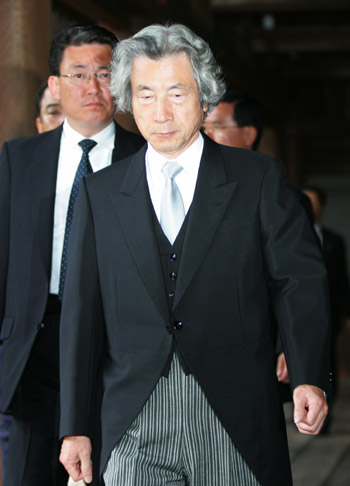
Japanese Prime Minister Junichiro Koizumi visits Tokyo's Yasukuni shrine August 15, 2006. Koizumi paid his respects at Tokyo's controversial Yasukuni shrine for war dead on Tuesday, the anniversary of his country's World War Two surrender, a parting shot sure to enrage neighbours China and South Korea. [Reuters] |
Koizumi, in a tailcoat, arrived at the shrine at around 7:40 am local time Tuesday (2240 GMT Monday). He then bowed in the main hall of the shrine.
The Chinese Foreign Ministry, in a statement, lodged a strong protest against Tuesday's visit by Koizumi to the shrine, which has been regarded as a symbol of the past Japanese militarism.
Koizumi has visited the shrine for five consecutive years since he took office in April 2001. But Tuesday's visit was the first he had ever paid on August 15, the anniversary of Japan's defeat in World War II.
Koizumi, who last visited the shrine on October 17, 2005, is expected to step down as leader of the ruling Liberal Democratic Party (LDP) as well as premier in September.
The Yasukuni Shrine, established in 1869 under Emperor Meiji, honors 2.5 million Japanese war dead including 14 class-A war criminals responsible for the most atrocious crimes during Japan's war of aggression against its Asian neighbors.
In 1978, the 14 class-A war criminals, including wartime prime minister Hideki Tojo, were listed as the enshrined at the Yasukuni Shrine.
Koizumi's visits to the shrine have been denounced by countries which suffered Japan's brutal aggression before and during World War II.
Koizumi's previous visits have chilled Japan's relations with neighboring China and South Korea, making the issue the major stumbling block in the smooth development of relations with those countries.
The visits also drew criticism from the public and mass media in Japan.
Finance Minister Sadakazu Tanigaki told reporters that Koizumi's visit to the Yasukuni Shrine is hard to understand from abroad.
Takenori Kanzaki, leader of the New Komeito party, the coalition partner of Koizumi's ruling LDP, expressed his regret over the visit.
"It is quite regrettable because (the visit came) on the symbolic day of August 15," he told reporters following Koizumi's visit.
Yukio Hatoyama, secretary general of the main opposition Democratic Party of Japan, said "the visit was an absurd act which could not be more irresponsible," according to Kyodo News.
Japanese Communist Party leader Kazuo Shii also criticized Koizumi over the visit. "The end-of-war anniversary should be a day when we express our resolve not to repeat the war of invasion. But (the premier) dared to go today. That merely made the issue of Yasukuni more complicated, " Shii told a press conference.
In a separate press conference, Mizuho Fukushima, head of the Social Democratic Party, said the premier's visit was a mistake.
"August 15 should be a day when we share a pledge of no more war. But (the premier) is trying to change the nature of the anniversary into a day of justifying sacrifice to state," she said.
After Koizumi's shrine visit on Tuesday, the Japan-China Friendship Association also voiced its strong protest.
In a statement sent to Xinhua, the general director of the association, Kyuhei Muraoka, said that they felt "indignant" over Koizumi's sixth visit to the shrine, where 14 top war criminals were honored, especially at a time when most Japanese were urging Koizumi to refrain from such visits.
The statement said most countries hope that Japan and China can be on friendly terms whereas Koizumi's action is against such wishes. Koizumi is responsible for the suspension of summit talks with East Asian leaders and the wreck of mutual trust with neighboring nations.
The association called on the next cabinet and the new prime minister, who was expected to assume the post in September, not to follow Koizumi's path.
The Japan War-Bereaved Peaceful Association National Communication Committee said in a statement that it strongly protests against the shrine visit and says NO to the visits to the Yasukuni Shrine. The group is scheduled to hold demonstrations against the shrine visit later Tuesday.
According to a recent opinion poll conducted by Japan's Yomiuri Shimbun newspaper, 49 percent of the respondents are opposed to Koizumi's shrine visit, compared with 43 percent in favor.