Asia-Pacific
Japanese leader snubs critics, prays at war shrine
(AP)
Updated: 2006-08-15 11:17
 |
Large Medium Small |
TOKYO - A defiant Japanese Prime Minister Junichiro Koizumi prayed at the Yasukuni war shrine Tuesday to mark Tokyo's World War II surrender, triggering immediate protests by China and South Korea but cheering his conservative followers.
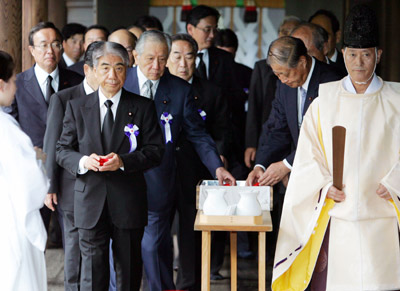 Former Labour and Welfare Minister Hidehisa Otsuji (front L) and other Japanese lawmakers are led by a Shinto priest as they visit Tokyo's Yasukuni shrine August 15, 2006, on the 61st anniversary of Japan's surrender during World War Two. [Reuters] |
It was Koizumi's sixth visit to the shrine since taking office in 2001, but his first on the highly symbolic August 15 anniversary of Japan's 1945 defeat. He is the first prime minister to visit on that day since Yasuhiro Nakasone in 1985.
The shrine visits have been a lightening rod for critics who accuse Japan of failing to fully atone for its military invasions in the 1930s and 40s. The shrine honors convicted war criminals among Japan's 2.5 million war dead.
Koizumi, who steps down as prime minister next month, made Tuesday's pilgrimage in the face of Chinese and South Korean warnings that it would further damage ties already frayed by earlier pilgrimages and other disagreements.
The prime minister defended the visit.
"I go there to remember and reflect on past wars and renew our resolve never to go to war again," he told reporters. "Today's peace and prosperity are not just because of those who are alive now, but were built based on those who sacrificed their precious lives."
The pilgrimage prompted angry protests from Beijing and Seoul, who consider the visits a sign that the Japanese government could one day return to militarism.
"This move ... seriously harms the feelings of those victimized by Japanese militarism during world War II and will undermine the political basis for ties between China and Japan," the Chinese Foreign Ministry said on its Web site.
The visit also drew fire from internal critics. Both Takenori Kanzaki, the leader of Koizumi's junior coalition partner, the New Komei Party, and Finance Minister Sadakazu Tanigaki criticized the pilgrimage.
Supporters, however, said the visits are justified. War veterans and ultra-rightists thronged the shrine Tuesday, some carrying banners with slogans such as, "The Greater East Asia War was not a war of aggression."
"I'm here for those who died for the country," Keiko Hara, 79, said as she visited the shrine Tuesday, Japanese flag in hand. "Foreign countries are blindly opposed to the visit, but our position is different."
Yasukuni, a shrine in Japan's native Shinto religion, has long been a symbol of Japanese imperialism. It played a high-profile role in promoting wartime fervor, and even today it hosts a museum that seeks to justify Japan's invasions of its neighbors.
Anti-shrine protesters staged candlelight vigils and marches in the days before the war anniversary. A group called the Peace War-Bereaved Association issued a protest Tuesday morning.
"We strongly urge Prime Minister Koizumi to keep to his heart the loss, sadness, and anger of those whose scars of war have not yet healed," the group said in a statement.
The heightened focus on Yasukuni and Japan's past war responsibility comes as Tokyo is taking a more assertive international diplomatic and military role.
Japan dispatched non-combat troops to Iraq in 2004 for two years in its largest and most dangerous military operation abroad since 1945. Tokyo is ramping up its military cooperation with the United States and campaigning hard for a permanent seat on the U.N. Security Council.