BEIRUT, Lebanon - Tens of thousands of Lebanese jammed bomb-cratered roads
Monday as they returned to still-smoldering scenes of destruction after a
tenuous cease-fire ended 34 days of vicious combat between Israel and Hezbollah.
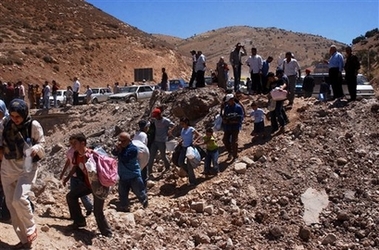
Lebanese citizens
carrying their belongings walk through a crater between the rubble at a
road between the Lebanese and the Syrian checkpoints, at the Masnaa
crossing, in the eastern Bekaa Valley, Lebanon, Monday, Aug. 14, 2006, as
they return to Lebanon after the U.N. cease-fire went into effect. A U.N.
cease-fire went into effect at 8 a.m. (0500GMT) Monday, after a night of
heavy airstrikes on Lebanon and 34 days of fighting that took more than
900 lives on both sides. [AP] |
Highlighting the fragility of the peace, Hezbollah guerrillas fired at least
10 Katyusha rockets that landed in southern Lebanon early Tuesday, the Israeli
army said, adding that nobody was injured. The army said that none of the
rockets, which were fired over a two-hour period, had crossed the border and so
it had not responded.
Lines of cars, some loaded with mattresses and luggage snaked slowly around
huge holes in the roads and ruined bridges. Many Lebanese expressed shock at
finding houses and villages flattened in more than a month of Israeli air and
artillery strikes.
Hezbollah fighters hugged each other and celebratory gunfire and fireworks
erupted in Beirut as the Islamic militant group's leader Sheik Hassan Nasrallah
claimed a "strategic, historic victory."
But Israeli Prime Ehud Olmert also claimed success, saying the offensive
eliminated the "state within a state" run by Hezbollah group and restored
Lebanon's sovereignty in the south.
In northern Israel, residents emerged from bomb shelters, hopeful that the
barrage of nearly 4,000 Hezbollah rockets that had rained down on towns and
villages since July 12 had ended ¡ª for now. Stores shuttered for weeks reopened
and some people returned to the beaches in Haifa, which suffered most from
guerrilla attacks.
President Bush said Monday that Hezbollah guerillas suffered a defeat at the
hands of Israel and he blamed the guerrilla group for the devastation. "There's
going to be a new power in the south of Lebanon," he said.
The conflict left nearly 950 people dead, 791 in Lebanon and 155 on the
Israeli side, according to official counts. An estimated 500,000 Israelis and
about 1 million Lebanese, or a quarter of the population, were displaced in the
conflict, government officials said.
The truce that took effect at 8 a.m. (1 a.m. EDT) largely held through its
first day, although skirmishes between Israeli forces and Hezbollah left six
guerrillas killed as both sides promised to retaliate when placed on the
defensive.
The odds of a durable end to the fighting depended on the quick deployment of
the Lebanese army and an international force into the 18-mile-deep band of south
Lebanon between the Litani River and the Israeli frontier.
A United Nations force that now has 2,000 peacekeepers in south Lebanon is to
grow to 15,000 troops, and Lebanon's army is to send in a 15,000-man contingent.
Lebanon's Defense Minister Elias Murr said Lebanese forces would be ready to
deploy north of the Litani River this week, but that was unlikely to satisfy
Israel, which wants a force along the border to rein in Hezbollah.
Murr also said the current U.N. peacekeeping force known as UNIFIL would
assume positions vacated by Israel before handing them over to the Lebanese
army, and he expected international troops to begin arriving within the next 10
days.
The French commander of UNIFIL, Maj. Gen. Alain Pellegrini, told The
Associated Press that additional troops were needed quickly because the
stability of the cease-fire was fragile. The region is "not safe from a
provocation, or a stray act, that could undermine everything," he said.
France and Italy, along with predominantly Muslim Turkey and Malaysia, have
signaled willingness to contribute troops to the peacekeeping force, but
consultations are needed on the force's makeup and mandate. Italian Foreign
Minister Massimo D'Alema said Italy's troops could be ready within two weeks.
In Jerusalem, officials said Israeli troops would begin pulling out as soon
as the Lebanese and international troops start deploying to the area. But it
appeared Israeli forces were staying put for now. Some exhausted soldiers left
early Monday and were being replaced by fresh troops.
While Israel claimed to have flooded south Lebanon with 30,000 soldiers in
its final offensive, an AP reporter who drove Monday from Tyre to the Israeli
border and through several destroyed villages along the frontier saw only one
Israeli tank.
Humanitarian groups sent convoys of food, water and medical supplies into the
south, but the clogged roads slowed the effort. U.N. officials said 24 U.N.
trucks took more than five hours to reach the port of Tyre from Sidon, a trip
that normally takes 45 minutes.
Israel urged Lebanese to stay out of the conflict zone in south Lebanon,
saying it was still dangerous because Israeli and Hezbollah fighters were in the
area. "Of course, the army would not open fire on civilians in the area," said
Capt. Jacob Dallal, an army spokesman.
The rush to return home came despite a standoff that threatened to keep the
cease-fire from taking root. Israel threatened to retaliate against any attacks,
while Nasrallah said the militia would consider Israeli troops legitimate
targets until they leave.
But Israeli Defense Minister Amir Peretz said that aside from the isolated
skirmishes that killed six Hezbollah fighters, the cease-fire was holding and
could have implications for future relations with Israel's neighbors. Both sides
appeared under strict orders to avoid confrontation.
The slain militants "were very close, they were armed, and they posed a
danger to the troops," Dallal said. "We're going to shoot anybody who poses an
imminent threat to the troops."
Hezbollah was believed to have suffered heavy casualties - it reported only
68 fighters killed, but Israel said the number was closer to 400.
Olmert also claimed his army largely destroyed the Hezbollah arsenal in the
conflict, which began July 12 when militants from the Shiite Muslim group
crossed the border and kidnapped two Israeli soldiers.
But the guerrilla organization emerged with far broader support in Lebanon
and the rest of the Arab world than it had going into the fight, meaning it will
be harder for the Lebanese government to enforce international demands for
Hezbollah's disarmament.
Now was not the time to debate the disarmament of his guerrilla fighters,
Nasrallah asserted confidently after his forces stood toe-to-toe against
Israel's vaunted military, able to fire rockets to the very end and blunt
attempts by an overwhelming Israeli ground force to wipe out guerrilla
positions.
"Who will defend Lebanon in case of a new Israeli offensive?" he asked,
sitting in front of Lebanese and Hezbollah flags. "The Lebanese army and
international troops are incapable of protecting Lebanon."
But Nasrallah said he was open to dialogue about Hezbollah's weapons at the
appropriate time. He also credited his group's weapons with proving to Israel
that "war with Lebanon will not be a picnic. It will be very costly."
The militant Shiite Muslim group, sponsored by Iran and Syria, claimed to
have killed vast numbers of opponents. The Israelis said they lost 118 in
combat.
The civilian toll was enormous, 692 in Lebanon and 39 in Israel and damage to
Lebanese infrastructure was sure to run into billions of dollars.
Whole towns and villages in the south were largely flattened, especially
along the border with Israel and a broad swath of the Hezbollah dominated
suburbs in south Beirut. Bridges and roads throughout the country were destroyed
and the Beirut airport remained closed. Israel said it would continue its
blockade of Lebanese ports but was no longer threatening to shoot any car that
moved on the roads south of the Litani.
Jamila Marina screamed and collapsed when she saw her destroyed home in
Yaroun, a mainly Christian village a few miles south of hard-hit Bint Jbail.
"Why did this happen. What have we done to deserve this!" she yelled.
Rosetta Ajaka, also just returned, found her badly damaged home had been used
as a Hezbollah outpost. A rocket launcher still sat in the front garden.
The political fallout was significant.
The unity that has governed Israeli politics was expected to quickly
fracture. Three Knesset members were ejected from the parliament during an
Olmert speech Monday for heckling and several others had called for a commission
of inquiry into the offensive.
Lebanese Prime Minister Fuad Saniora faced the threat of a government
collapse as well, given the task of disarming Hezbollah fighters. The group has
two Cabinet ministers and 14 votes in Parliament and could easily undo
government unanimity when a vote is taken on the Hezbollah disarmament issue, as
is demanded by the international community.
The dangers for Lebanese civilians were great as well. At least one child was
killed and 15 people were wounded by ordnance that exploded as they returned to
their homes in south Lebanon, security officials said.
Many of those filtering back in looked dazed, unable to recognize their
neighborhoods.
"I just want to find my house," said Ahmad Maana, an old man who wandered
back on foot after spending more than a week hiding in the nearby hills.
Two young men in khakis were spotted carrying semiautomatic rifles, and
others talked into two-way radios. A few carloads of young men screeched into
Kafra and jumped out of their cars, kissing waiting comrades on each
cheek.
