LONDON - Authorities have warned Britons to remain vigilant, saying they may
still be in the crosshairs of Islamic terrorists after security forces foiled an
alleged plot to bring down packed trans-Atlantic planes heading to the United
States.
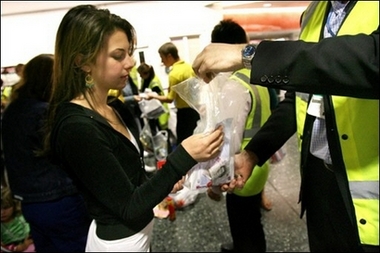
Air passengers have
their transparent bags searched before entering the departure lounge at
Gatwick Airport in London over the weekend. Britain downgraded its
security threat level as it appeared that police had apprehended all of
the main figures in an alleged terror plot, a decision that was likely to
ease traveller frustrations at the country's
airports.[AFP] |
Onerous security checks and frayed tempers faced travelers again at the
country's main airports.
Home Secretary John Reid said authorities were conducting two dozen separate
counterterrorism investigations in Britain, and there was no guarantee the
government would be able to thwart every plot.
"We believe we have the main targets from this particular surveillance and
plot," Reid told British Broadcasting Corp. television. "(But) there are still
people out there who would carry out such attacks."
Those sentiments were echoed across the Atlantic by U.S. Homeland Security
chief Michael Chertoff, who said there was a risk that other groups might try to
cause bloodshed on the false assumption that law enforcement and intelligence
services might be distracted.
He also called for taking a renewed look at U.S. laws that could give
authorities the flexibility to detain suspects for longer periods of time.
Britain recently passed controversial legislation giving the government up to 28
days to hold terror suspects without charge, and the jetliner plot is the first
major test of how those new powers will be utilized.
British police on Sunday were questioning 22 of the suspects in detention,
but authorities remained silent on what, if anything, they have learned. For the
third straight day, there were no briefings by police or government officials,
leaving the British press to speculate on a wide range of theories.
The Sunday Mirror tabloid asserted that a female suspect in custody may have
been planning to use her own baby as a deadly diversion to smuggle a bomb onto
the plane, but it did not name its sources. The Sunday Times reported that one
of those in custody was believed to be al-Qaida's leader in Britain, but it did
not say which of the suspects it was. And The Independent on Sunday cited
security sources as saying terrorists were planning an "Apocalyptic wave" of
attacks.
There was plenty of time for travelers to soak up all of those theories as
they sat in long lines at airports in the United Kingdom, particularly London's
Heathrow and Gatwick. Almost a third of flights out of Heathrow were canceled
Sunday, and a ban on all carry-on items remained in effect. British Airways
canceled almost 100 flights to Europe from Heathrow and scrapped all its
domestic flights from Gatwick. Most long-haul flights were operating, although
10 BA services to the United States were canceled.
Some airlines have accused the British Airports Authority, which operates
seven of the country's major airports of failing to cope with the new
anti-terror security requirements, and others appealed to the British government
to use police and army reservists to speed up searches at overloaded airport
security checkpoints.
"If we the industry and the government don't work together to have sensible
security ... we are going to hand these extremists a terrific PR success,"
Michael O'Leary, the chief executive of budget airline Ryanair, told Sky News
television. "We don't need to be body searching young children traveling with
their parents on holiday to Spain."
Police arrested 24 people across England on Thursday, saying they had
thwarted a plot to blow up as many as 10 passenger planes flying between Britain
and the United States. One suspect was released without charge, and a court will
decide Monday on the detention of another. That last suspect cannot be
questioned in the interim.
Another 17 people are in detention in Pakistan, including Rashid Rauf, a
British national named by Pakistani intelligence as one of the key suspects.
Rauf was picked up along the Pakistan-Afghanistan border, and is believed to
have connections to a senior al-Qaida leader in Afghanistan.
In Kabul, Afghanistan's Foreign Ministry on Sunday denied any Afghan
connection, saying the country _ home to thousands of NATO and American troops
was no longer a safe place for al-Qaida to operate.
"As the recent evidences and ongoing investigations have revealed, al-Qaida
continues to enjoy safe haven outside Afghanistan," the ministry said in a
statement, calling Pakistan's allegation "diversionary."
Afghanistan has long complained that Taliban and other militants are able to
hide on Pakistan's side of the border, and that Islamabad must do more to stop
them.
