WASHINGTON - Since the Sept 11 attacks, aviation security has been tightened
in many areas - but not all. Before they were foiled, terrorists apparently
planned to exploit some of the remaining weaknesses in aviation security by
assembling improvised bombs right inside airline passenger cabins.
The 2001 hijackings led to bulletproof cockpit doors. Machines that could
detect explosives in checked baggage were installed in commercial airports.
Sharp objects that could be used as weapons were banned, and better-trained
airport screeners were hired to look for them.
|
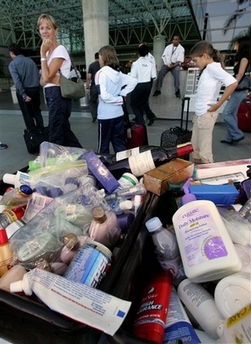
A traveler looks at
abandoned items at the Los Angeles International Airport, in Los Angeles,
Thursday Aug 10, 2006. Airport security passed along passengers a
prohibited item list that included: liquids and gel, beverages, perfume
and cologne containers, shampoo, creams toothpaste, hair gels and other
items of similar consistency. The United States issued its highest
terrorism alert for commercial flights from Britain and raised security
for all air travel Thursday after a major terror plot was foiled in
London. [AP]
|
So it may have been predictable that terrorists would try something else:
smuggle aboard liquids that could be turned into explosives, put them together
with other bomb parts and then detonate them.
"We've armored the flight deck doors, so they won't take planes and use them
as weapons," said Oregon Rep. Peter DeFazio (news, bio, voting record), a
leading Democrat on the
Homeland Security Committee. "Bag screening is
better. The easiest way to do it is on a person or carryon."
On Friday, security was expected to intensify in U.S. airports with airline
passengers facing a double-screening process, the head of the airline industry's
largest trade group said. The extra screening was designed to keep passengers
from carrying aboard any liquids that might be fashioned into explosives.
Passengers and their carry-on luggage were to be examined not only at the
main security checkpoint but also a second time at the boarding gate. The
stepped-up screening began Thursday at 25 airports with flights bound for
Britain, according to James May, president of the Air Transport Association.
Intelligence had indicated the terror plot unfolding in Britain involved
using benign liquids that could be mixed inside an airplane cabin to make an
explosive.
Noting that terrorists repeat their tactics, DeFazio pointed to the 1994-1995
attempt to blow up a dozen airliners simultaneously over the Pacific Ocean. The
plot, code-named "Bojinka," involved liquid explosives smuggled onto planes in
bottles of contact lens solution.
The response to the latest terrorist threat produced long lines at airports
Thursday as security officials scrambled to put new measures in place and
passengers adjusted to perplexing new restrictions.
With a dearth of security equipment that can detect explosives on passengers,
U.S. security officials moved quickly to ban liquids from passenger cabins. By
day's end British Airways had banned carry-on bags from all flights between the
United States and Britain.
Earlier Thursday, carryons were barred from U.S.-bound flights to keep
passengers from carrying liquids onto aircraft. Then the ban was extended to all
flights between the United States and Britain.
British Airways carries by far the most passengers between the two countries.
The airline runs 80 flights daily between Britain and 19 U.S. airports.
Pilots complained that they weren't told quickly enough about the threat.
"The pilots are the in-flight security coordinators," said Al Aitken, a
retired pilot who is a member of the Passenger Cargo Security Group, which
lobbies for better aviation security. "How can he be that without knowing the
latest information on the imminent threat? How can he brief his crew on what to
look for?"
Rafi Ron, former head of security at
Israel's Ben Gurion Airport and
now a security consultant in Washington, said terrorists always try to exploit
new vulnerabilities.
"We've been investing 99.9 percent of our resources in technology with one
single purpose: the detection of weapons," Ron said. "Terrorists will always be
able to get around it."
