JERUSALEM - Israel believes it will be able to reduce the threat posed by
Hizbollah missiles by targeting resupply convoys and by getting an international
force to keep rockets out of south Lebanon, Israeli government officials said.
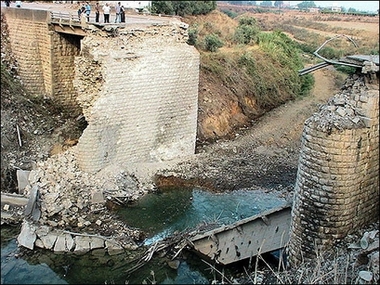
Lebanese inspect a
bridge destroyed by Israeli air strikes in Akkar, a region of north
Lebanon bordering on Syria. At least 15 Israelis were killed and dozens
wounded by Hezbollah rocket fire as Israel faced its bloodiest day on the
homefront since launching its offensive in Lebanon.
[AFP] |
The officials, who spoke on condition of anonymity, said they expected the
U.N. Security Council to pass a resolution this week ending Israel's offensive
operations but leaving the door open for continued air strikes on Hizbollah arms
convoys and rocket launching crews.
Israeli Prime Minister Ehud Olmert and Defence Minister Amir Peretz plan to
meet senior defence officials on Monday morning to discuss their options.
Israel wants the international stabilisation force to keep Hizbollah out of a
20 km (13 mile) zone between Israel and the Litani River, as called for in the
draft U.N. resolution.
Senior government officials said doing so would reduce the threat of
short-range rockets hitting northern Israeli towns.
To deal with Hizbollah's long-range rockets, Israel would carry out targeted
air strikes against resupply convoys and get the international force to police
the Lebanese-Syrian border, the officials said.
Rockets fired by the guerrillas killed 15 people in northern Israel on
Sunday, including 12 army reservists.
Those deaths brought to 48 the number of people killed in northern Israel in
rocket strikes since war broke out on July 12 after Hizbollah seized two
soldiers in a cross-border raid.
One senior Israeli official said the targeting of Hizbollah arms convoys
"falls under the rubric of defensive moves, which are ostensibly allowed by us."
"Preventing Syrian and Iranian resupply is a key," he added, referring to
Hizbollah's main backers.
Israeli officials estimated that between 75 percent and 80 percent of
Hizbollah's long-range rockets have been destroyed, although some Western
diplomats were sceptical.
Israeli officials believe Hizbollah may be reluctant to use its remaining
stock of long-range rockets at this time, especially if resupply routes are cut
off.
The Iranian-supplied Zelzal-2 missiles have been Israel's main strategic
concern. They have a range of 210 km (130 miles), putting the Israeli commercial
capital Tel Aviv within reach.
But Hizbollah has also launched so-called "Khaibar 1" rockets some 80 km (50
miles) into Israel, threatening several cities far beyond Haifa.
"The way we exercise it (defensive action) will depend on the international
force's mandate. If they are only monitors, the definition will be broad," a
senior government official said.
Foreign Ministry spokesman Mark Regev declined to say if attacking Hizbollah
convoys would constitute defensive action.
But he said: "We wouldn't want, on day one of a ceasefire, to see
semi-trailer after semi-trailer coming from the Syrian border full of Iranian
missiles, Iranian rockets, Iranian explosives. Then Hizbollah would just re-arm
and we'd be back to square one."
Israel is also pushing for several changes to the draft U.N. resolution,
seeking greater assurances the international force would block Hizbollah's
resupply as well as removing any mention of the disputed Shebaa Farms territory.
The tiny strip of Israeli-occupied land was deemed by the United Nations to
be part of Syria unless Lebanon, which claims the territory, demarcated new
borders with Syria, which has not happened.
