JERUSALEM - When the fighting is over, both Israel and Hezbollah are likely
to declare victory. But the truth will be far more complicated.
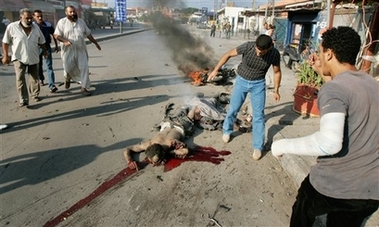
Residents rush to the
scene seconds after a double Israeli missile attack, believed to have
originated from a drone, struck and killed two men on a motorcycle in a
street in Tyre, southern Lebanon Saturday, Aug. 5, 2006. Tyre was the
scene of an overnight gunbattle between Israeli naval commandos and
Hezbollah fighters, and the two men on the motorcycle appeared to have
been specifically targeted. [AP] |
Hezbollah looks certain to be pushed back from Israel's border, but its
standing in the Arab world will remain high. Israel appears set to achieve its
goal of getting Hezbollah off its doorstep, but the guerrillas can say they
stood up to Israel and lived to tell the tale.
Because of each side's deep-seated need to appear victorious, a thunderous
show of force is not unlikely in the time before a cease-fire deal is arranged _
perhaps a Hezbollah rocket hitting Tel Aviv, or a massive Israeli ground
offensive northward toward the Litani River.
Israel hopes that its offensive in Lebanon, which has already killed more
than 500 people, will serve as a warning to Iran, Syria and all Islamic radicals
in the Middle East that the price for attacking the Jewish state is too high
even to contemplate.
And it hopes its ability to withstand an onslaught of nearly 2,500 Hezbollah
rockets will send a strong message of defiance to its enemies.
"Israeli society showed the myth of a weak society is not true," said Efraim
Inbar, a professor of political studies at the Bar-Ilan University near Tel
Aviv. "I think the region will pay attention."
Israel has not achieved the deterrence it hoped for, however and it's hard to
imagine a scenario in which Hezbollah will feel defeated.
The Shiite group, which sparked the crisis by crossing into Israel and
capturing two Israeli soldiers July 12, has kept up its rocket barrage,
including some 190 rockets Friday. Hezbollah also made good on its threat to
strike deeper and deeper inside Israel, hitting the town of Hadera, 50 miles
south of the border, for the first time Friday.
Israel's initial condition for a cease-fire, the disarming of Hezbollah has
been replaced by the far more modest goal of pushing Hezbollah away from the
border to make room for a new multinational peacekeeping force.
The group has proven itself to be a more formidable foe than expected.
Forty-four Israeli soldiers have died in the fighting, in addition to 30
civilians killed by rocket attacks.
"In their minds they (Hezbollah) won this one," said Timur Goksel, an
American University of Beirut professor who spent more than two decades as a
senior U.N. adviser in south Lebanon. "And their credibility within their own
community is very high. Their credibility in the Muslim world is very high. They
fought the Israelis for three weeks without buckling under."
Added Ephraim Halevy, former head of the Mossad spy agency: "Hezbollah built
a force of mutual deterrence against Israel. But it's not Hezbollah that built
it. It was Iran."
For Israel, the victory narrative is a matter of life and death.
The conflict in Lebanon has reinforced Israelis' deeply ingrained feeling
that they are surrounded by enemies who want them dead, bringing a rare sense of
clarity to a national psyche blurred by the moral murkiness of the conflict with
the Palestinians.
Most Israelis believe winning the war and being perceived as winning it is
essential for the Jewish state's long-term security.
That helps explain why popular support for the Lebanon campaign remains
extremely high despite a growing chorus of media commentators complaining that
the war has been poorly conceived and executed.
Israel's Channel 10 TV released a new poll Friday night showing 84 percent of
Israelis are satisfied with the army's performance, with only 8 percent
dissatisfied. No margin of error was given.
Most Mideast observers agree that to be seen as winning, Hezbollah needs only
to emerge from the conflict with its war machine still functioning, an outcome
that now appears very likely.
In an interview with The Associated Press on Wednesday, Israeli Prime
Minister Ehud Olmert said the disarming of Hezbollah will come only after a
cease-fire is in place and a beefed-up multinational peacekeeping force takes up
positions in south Lebanon,an arrangement the U.N. Security Council is now
seeking to put together.
William Brown, U.S. ambassador to Israel from 1988 to 1992, said that even if
Israel succeeds in pushing Hezbollah away from its northern border and an
international force moves in, Hezbollah's rockets will still be able to reach
Israel, firing "over the heads" of peacemakers.
"Unless you get a more comprehensive type of solution, the arms will continue
to flow in from Iran through Syria," he said.
Disrupting that arms supply explains Israel's decision on Friday to target
bridges in the Christian heartland north of Beirut for the first time.
Israeli military officials said Friday they had achieved the first phase of a
plan to secure a 4-mile buffer zone in south Lebanon, though pockets of
Hezbollah resistance remained.
Defense Minister Amir Peretz has told top army officers to begin preparing
for a push to the Litani River, about 20 miles north of the border, a move that
would require Cabinet approval and could lead to many more
casualties.
