BOURJ AL-MULOUK, Lebanon - Hezbollah fired its biggest and deepest volley of
rockets into Israel on Wednesday as Israel pursued the guerrillas with 8,000
soldiers on the ground and heavy bombing. With fighting in its fourth week and
diplomatic efforts stalled, the region braced for a bitter and long war.
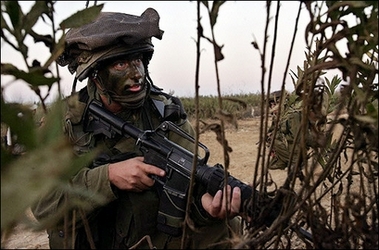
An Israeli soldier
takes position with his M-16 rifle as he waits for orders to enter
southern Lebanon, along the northern Israeli border. Hezbollah fired its
biggest salvo of rockets at Israel after the Jewish state's commandos
struck deep into Lebanon, snatching five suspected guerrillas in a
helicopter raid.[AFP] |
In eastern Lebanon, villagers wept as heavy machinery carried off the bodies
of those killed in an overnight raid against a Hezbollah stronghold. Across
northern Israel, forests and fields lay scorched from rocket fire that killed a
Massachusetts native fleeing on his bicycle after a warning siren went off.
Hopes for a cease-fire dimmed despite a plea from Pope Benedict XVI for a
quick solution. U.N. diplomats debated a draft resolution that would lay down
the conditions for an international force to go in; they claimed they were
making progress but acknowledged no immediate deal was in sight.
The prospect of a longer war has raised tensions across the Mideast, where
anti-Israeli and anti-American hostility is now sharp. Arab leaders have warned
repeatedly in recent days that the fighting has hampered, or killed outright,
any hope for a long-term Israeli peace deal.
But Israeli Prime Minister Ehud Olmert said his country would stop its
offensive only after a robust international peacekeeping force is in place in
southern Lebanon, something likely to take weeks at minimum. He predicted the
fighting would create "new momentum" for Israel's plan to separate from the
Palestinians by pulling out of the West Bank.
On the first full day of its massive ground push, Israeli military officials
said Hezbollah was putting up resistance as troops went from village to village
in south Lebanon to clear them of guerrillas.
But the officials, speaking on condition of anonymity because they were not
authorized to talk to the media, said they were confident the resistance would
not change their objective of reaching roughly four miles into Lebanon by
Thursday. They said they could easily dash inland to the Litani River - their
final objective about 18 miles from the border, but instead chose to move
methodically so as not to leave pockets of resistance.
The Israeli forces were believed to be just two miles inside the Lebanese
border in most spots.
Hezbollah's retaliation was fierce, both on the ground and by air. It fired a
record daily number of more than 230 rockets into Israel, pushing its three-week
total over the 2,000 mark. The highest previous daily total was 166, on July 26.
One rocket on Wednesday hit near the town of Beit Shean, about 42 miles
beyond the border, Hezbollah's deepest rocket strike into Israel so far. Another
stray missile hit the West Bank for the first time.
David M. Lelchook, a 52-year-old Israeli-American, was killed as he fled for
home by bicycle near a northern town, and 58 people were wounded elsewhere
across Israel. Lelchook was originally from the Boston area and had been living
in Israel for 20 years, said Yehuda Shavit, a local government official. He said
the man's wife and two daughters had moved to southern Israel earlier in the
fighting.
Another American immigrant was among three Israeli soldiers killed in
fighting in Lebanon this week, the army said Wednesday. Michael Levin, 22, moved
to Israel three years ago from Pennsylvania and enlisted in the paratroopers,
Israeli media reported. Levin cut short a visit to his family four days ago and
returned to his unit.
In Lebanon, the civilian death toll reached far higher: 16 killed overnight
during an Israeli commando raid and accompanying airstrikes around the Hezbollah
stronghold of Baalbek near the Syrian border.
The attack, the deepest strike north by Israel so far, was led by commandos
who flew in by helicopter before dawn, capturing five Hezbollah guerrillas and
killing at least 10, said Israel's army chief, Lt. Gen. Dan Halutz.
Witnesses said the Israeli forces partially destroyed the Dar al-Hikma
hospital in Baalbek, which residents said is financed by an Iranian charity
close to Hezbollah.
A Hezbollah official in Beirut said the hospital had been evacuated several
days earlier as a precaution after Israeli forces attempted an earlier, similar
operation. No such assault was previously reported.
The Israel air force deputy commander, Col. Yochanan Loker, described the
site as "a Hezbollah headquarters located inside the hospital. ... Weapons were
found within the hospital in offices, in drawers."
Israel has not released the identities of those captured. When asked by The
Associated Press whether any were "big fish," Olmert said: "They are tasty
fishes."
Another Hezbollah official, also speaking on condition of anonymity because
he was not authorized to give official statements to the media, said Israeli
troops captured "four or five" people, but not at the hospital, and denied they
were Hezbollah fighters.
Commandos also took away computers, disks and documents for intelligence
analysis, said army Col. Nitzan Alon, who led the Israeli ground forces on the
mission. As they swept the building, they came under fire by anti-tank missiles
from nearby buildings.
Israeli jets fired missiles at the surrounding guerrilla force as the
fighting at the hospital raged, the military said.
One struck the nearby village of al-Jamaliyeh, hitting the house of the
village's mayor, Hussein Jamaleddin, and killing his son, brother, and five
other relatives.
Weeping as he walked in a funeral procession hours later, Jamaleddin pulled
at the limbs of the dead, carried to a cemetery in the bucket of a yellow
front-loader.
"This is the leg of my son. He was a sportsman, he did tae kwon do,"
Jamaleddin wailed.
At least 548 Lebanese have been killed since the fighting began three weeks
ago, including 477 civilians and 25 Lebanese soldiers and at least 46 Hezbollah
guerrillas. The health minister says the toll could be as high as 750, including
those still buried in rubble or missing.
In all, 55 Israelis have died, 36 soldiers as well as 19 civilians killed in
Hezbollah rocket attacks.
