BEIRUT, Lebanon - Israel launched a major attack deep into Lebanon, and
Hezbollah said its guerrillas were fighting Israeli commandos trapped inside a
hospital in the eastern city of Baalbek early Wednesday.
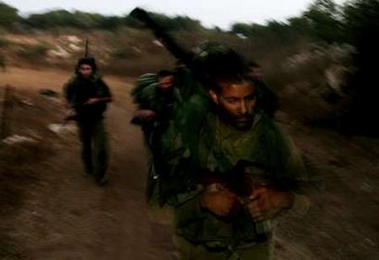
Israeli soldiers
prepare to enter Lebanon, next to the Israeli-Lebanese border August 1,
2006. [Reuters] |
The Israeli army would not comment on the operation in the ancient city,
which was once a Syrian army headquarters some 80 miles north of Israel. The Web
site of the Israeli daily Haaretz reported that "helicopters put down IDF
(military) commandos near Baalbek," without adding details.
The ferocity of the battles in Baalbek and across southern Lebanon on
Tuesday, the determination of the Israelis to keep fighting and the minimal
diplomatic progress toward a cease-fire all indicate the 3-week-old war is more
likely to escalate than end soon.
Hezbollah's chief spokesman, Hussein Rahal, told The Associated Press that
Israeli troops landed near Dar al-Hikma Hospital and that fierce fighting was
raging after more than one hour.
"A group of Israeli commandos was brought to the hospital by a helicopter.
They entered the hospital and are trapped inside as our fighters opened fire on
them, and fierce fighting is still raging," Rahal said.
Rahal said Hezbollah was using automatic rifles and rocket-propelled
grenades, and that Israeli jets were attacking the surrounding guerrilla force
with rockets.
He dismissed as "untrue" reports that the Israeli commandos managed to snatch
some patients from the hospital and spirit them away in helicopters. Hezbollah's
capture of two Israeli soldiers in a July 12 cross-border raid triggered the
ongoing Israeli offensive in Lebanon.
Witnesses said the hospital was hit in an Israeli airstrike and was burning.
Repeated telephone calls to the hospital went unanswered.
Baalbek is a city with spectacular Roman ruins as well as the barracks of the
Iranian Revolutionary Guards when they trained Hezbollah guerrillas there in the
1980s.
The last time Israel forces were known to have gone that far on the ground
into Lebanon was in 1994, when they abducted Lebanese guerrilla leader Mustafa
Dirani, hoping to use him to get information about missing Israeli airman Ron
Arad. Dirani was released in a prisoner exchange 10 years later.
In southern Lebanon on Tuesday, troops battled guerrillas after Israel
ordered its army to punch all the way to the Litani River. Thousands of troops
were operating along the Israel-Lebanon border. Additional soldiers crossed into
Lebanon on Tuesday, Israeli defense officials said, joining forces already
fighting there.
They entered through four different points along the border and moved at
least four miles inside Lebanon. Thousands of reservists, called up over the
weekend, also were gathering at staging areas on the Israeli side of the border,
ready to join the battles and extend the invasion.
Israeli officials said their soldiers were to go as far as the Litani, about
18 miles from the border, and hold the ground until an international
peacekeeping force comes ashore.
But the army later said it had distributed leaflets northeast of the river at
villages where Hezbollah was active. The leaflets told people to leave,
suggesting that the new offensive could take Israeli soldiers even deeper into
Lebanon.
Despite mounting civilian deaths, President Bush held fast to support for
Israel and was pressing for a U.N. resolution linking a cease-fire with a
broader plan for peace in the Middle East. Staking out a different approach,
European Union foreign ministers called for an "immediate cessation of
hostilities" followed by efforts to agree on a sustainable cease-fire.
Israeli Prime Minister Ehud Olmert said it was not in Israel's interest to
agree to an immediate cease-fire because every day of fighting weakens the
guerrillas.
"Every additional day is a day that drains the strength of this cruel enemy,"
he said. "Every extra day is a day in which the (army) reduces their capability,
contains their firing ability and their ability to hit in the future."
The Israelis want to keep Hezbollah off the border so their patrols and
civilians along the fence are not in danger of attack. The army also hopes to
push Hezbollah far enough north so that most of the guerrillas' rockets cannot
reach the Jewish state.
