Asia-Pacific
S. Korea's Roh likely to suffer by-election
(Reuters)
Updated: 2006-07-26 13:52
 |
Large Medium Small |
South Korea's president Roh Moo-hyun faced another likely setback to his leadership on Wednesday as voting started in parliamentary by-elections that were expected to be swept by the main opposition.
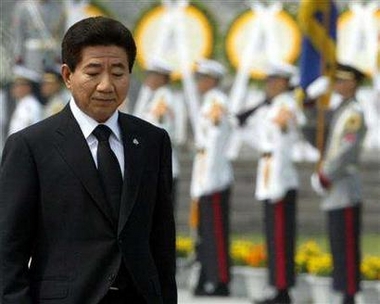 South Korean President Roh Moo-hyun walks during an anniversary of the Memorial Day at the national cemetery in Seoul, June 6, 2006. Roh faced another likely setback to his leadership on Wednesday as voting started in parliamentary by-elections that were expected to be swept by the main opposition. [Reuters] |
Pre-election polling indicated the conservative Grand National Party would win three or all four of the seats up for grabs. Roh's left-of-centre Uri Party was expected to be shut out, and the liberal Democratic Party had a shot in one race.
Uri and Roh, battling the lowest public support ratings of his presidency, have not fared well in recent elections. The Grand National Party overwhelmingly won local races in May while Uri failed to win a parliamentary seat in two by-elections in 2005.
Roh was criticised after North Korea test-fired seven missiles on July 5 despite international warnings against the move. Several leading voices charged his government of being too soft with its policy of engaging its reclusive neighbour.
Polling conducted before the launch showed Roh's support rate already at just 15 to 20 percent.
South Koreans are increasingly sceptical about the efficacy of increasing ties with the North under the "Sunshine Policy", first started by Roh's predecessor Kim Dae-jung.
"The 'Sunshine Policy' has lost some of its legitimacy among the Korean public because of the North Korean missile test. This undermines the influence of President Roh," said Lee Nae-young, a political science professor at Korea University.
The wavering support for Roh and Uri, which translates as "us" or "our", has made it difficult for the government to enact its agenda of reforms for the corporate and property sectors.
The Grand National Party, which is considered to be more pro-business, has called for cuts in income and corporate taxes to spur spending in South Korea, the world's 11th-largest economy.
South Korea's economy grew at its slowest pace in more than a year in the second quarter on weak construction spending, data showed on Tuesday.
There are not enough seats up for grabs to change Uri's leading position in South Korea's 299-seat unicameral parliament.
Uri holds 142 seats, the Grand National Party has 123 while minor parties and independents hold the remainder.
Three of the contested seats are in the Seoul metropolitan area, and one is in the southeast part of the country.
One of the worst possible scenarios for Roh would be a GNP victory in three of the races and a victory for the Democratic Party in the final race. Analysts said this would indicate Uri has lost favour among left-of-centre voters.
Analysts said the GNP candidate will likely have the upper hand in the December 2007 election for president.
In the May local elections, the GNP had a national support rate of 60.8 percent while Uri attracted just 18.1 percent, the National Election Commission said.