Prime Minister Ehud Olmert said on Tuesday he was determined to pursue
Israel's offensive against Hizbollah as he met U.S. Secretary of State
Condoleezza Rice to discuss the war in Lebanon.
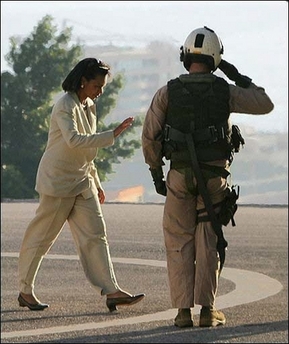
US Secretary of State
Condoleezza Rice salutes a US Marine as she walks towards a helicopter
upon her departure from Beirut after meeting with Lebanese officials. Rice
was to hold crisis talks with Israeli Prime Minister Ehud Olmert and
Palestinian president Mahmud Abbas as part of a high-stakes mission to end
the Middle East crisis, as deadly violence raged on in
Lebanon.[AFP] |
"We are using the basic elementary
right of self-defence," Olmert said alongside Rice in remarks before they held
talks.
Amid mounting international concern at civilian casualties, Rice met Lebanese
leaders in bomb-battered Beirut on Monday.
She unveiled truce proposals there similar to Israel's demand for Hizbollah
to pull back from the border to allow an international force to deploy, Lebanese
politicians said.
"A durable solution will be one that strengthens the forces of peace and
democracy in the region," Rice said with Olmert.
"It is time for a new Middle East. It is time to say to those who do not want
a new Middle East that we will prevail."
On the battlefield, Israeli forces seized the key Hizbollah stronghold of
Bint Jbeil inside southern Lebanon after fierce clashes with guerrillas in the
town, Israel Radio reported.
Both an army spokesman and Hizbollah's Manar TV said fighting was still going
on.
An Israeli air strike killed a family of seven, Lebanese security sources
said. Hizbollah said five guerrillas died in the past two days. Israel reported
two soldiers killed on Monday but said it had inflicted dozens of casualties on
Hizbollah.
A total of 390 people in Lebanon and 41 Israelis have been killed in the
conflict, ignited by Hizbollah's capture of two Israeli soldiers on July 12.
While saying she has no plan for Middle East shuttle diplomacy, Rice's
schedule this week resembles just that. She arrived in Jerusalem after her trip
to Beirut and will also visit Palestinian President Mahmoud Abbas in Ramallah.
Rice has made clear she is not seeking a quick ceasefire and that any
solution should address the root causes of the conflict - for which Washington
and Israel blame Hizbollah and its backers in Iran and Syria.
Israel's army, which has also waged a military campaign in Gaza since June 28
to recover a soldier seized by Palestinian militants, believed it may have a
week to keep pounding Hizbollah before a deal was reached, security sources
said.
The heaviest fighting has been taking place around the town of Bint Jbeil.
Israeli forces seized nearby another stronghold, the village of Maroun al-Ras,
last week.
Among the issues on the table at Rice's meetings are U.S. demands Hizbollah
withdraw away from Israel's border, the deployment of an international force
alongside the Lebanese army in the area and the return of the Israeli soldiers.
Rice and Olmert were also expected to deal with what can be done to ease the
suffering for civilians in Lebanon, which estimates almost one-fifth of its
population has been displaced by Israeli bombing. Most of the dead are
civilians.
Olmert said Israel was "very conscious" of the humanitarian needs of
civilians in Lebanon.
The United States backs the idea of a humanitarian corridor to get help to
the needy, an idea Israel says it could support.
One of the key sticking points for a ceasefire is the sequence of events for
a deal.
Lebanese parliament speaker Nabih Berri, an ally of Hizbollah and close to
Syria, told Rice in Beirut a ceasefire should come first, followed by an
exchange of prisoners and then discussion of other issues, a Lebanese political
source said.
Prime Minister Fouad Siniora, who has pleaded for an immediate ceasefire, was
more open to Rice's proposal and discussed ways of developing her ideas, his
office said.
Israel wants Hizbollah to leave the border area immediately and free the
captured soldiers without conditions.
Many of the issues will be discussed at an international conference in Rome
on Wednesday.
But ground raids and air strikes have failed to stop Hizbollah firing rockets
into northern Israeli cities, where they have killed 17 civilians so far. More
than 100 rockets fell on Monday, wounding at least 11 people.
Israel says it would accept an international force to dislodge Hizbollah
guerrillas from the border and several European Union nations have said they
were ready to contribute to a U.N. peace force.
But just as Hizbollah has fought Israeli attempts to drive it from the south,
it would likely resist an international effort to do the same.
Israel's Lebanon offensive has coincided with its push into the Gaza Strip to
try to recover the soldier captured by Palestinian militants and halt rocket
fire. Israeli forces have killed at least 121 Palestinians in the month since
then.
