Mideast diplomats were pressing Syria to stop backing Hezbollah as the
guerrillas fired more deadly rockets onto Israel's third-largest city Sunday.
Israel faced tougher-than-expected ground battles and bombarded targets in
southern Lebanon, hitting a convoy of refugees.
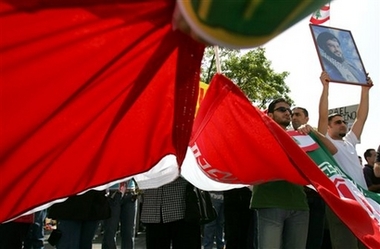
Lebanese men hold
Iranian flags and a poster of Hezbollah leader, Sheik Hassan Nasrallah,
during a protest outside of Israel's embassy in Caracas, Venezuela,
Thursday, July 20, 2006. Venezuelans of Arab descent were joined by
supporters of President Hugo Chavez as they marched through the capital
protesting Israel's military offensive in Lebanon.
[AP] |
Israel's defense minister said his country would accept an international
force, preferably NATO, on its border after it drives back or weakens Hezbollah.
But his troops described the militants they encountered as a smart,
well-organized and ruthless guerrilla force whose fighters do not seem afraid to
die.
With Secretary of State Condoleezza Rice arriving in Israel on Monday, both
the Arabs and Israelis appeared to be trying to set out positions ahead of
Washington's first diplomatic mission to the region since the fighting began.
The United States backs Israel's refusal to talk about a cease-fire until it
completes the military campaign against Hezbollah, but is under increasing
pressure to foster a plan to end the growing suffering and destruction in
Lebanon.
Still, daily casualty figures appeared to be falling, about nine confirmed
Sunday by Lebanese security officials, compared with dozens each day earlier in
the week. The decrease could be a result of the exodus from the hardest-hit
areas or because of the difficulty for authorities in getting figures from the
war zone.
In the 12th day of fighting, guerrillas launched more than a dozen rockets at
the Israeli city of Haifa, killing two people. Israeli missiles struck a convoy
of fleeing Lebanese, killing four people, including a journalist.
In the far south, fighting with Hezbollah raged around the Israeli military's
foothold in Lebanon, the border village of Maroun al-Ras, where the Israeli army
has maintained a significant presence since Saturday. But so far they were not
advancing. Hezbollah reported three of its fighters killed.
Israeli military officials said their forces captured two Hezbollah
guerrillas on Sunday. The officials spoke on condition of anonymity because they
were not authorized to talk to reporters. Israel Army Radio reported the two
were the first prisoners Israel has taken in this offensive.
With Israel and the United States saying a real cease-fire is not possible
until Hezbollah is reined in, Arab heavyweights Egypt and Saudi Arabia were
pushing Syria to end its support for the guerrillas, Arab diplomats in Cairo
said.
A loss of Syria's support would deeply weaken Hezbollah, though its other
ally, Iran, gives it a large part of its money and weapons. The two moderate
Arab governments were prepared to spend heavily from Egypt's political capital
in the region and Saudi Arabia's vast financial reserves to break Damascus from
the guerrillas and Iran, the diplomats said.
Syria said it will press for a cease-fire to end the fighting, but only in
the framework of a broader Middle East peace initiative that would include the
return of the Golan Heights. Israel was unlikely to accept such terms but it was
the first indication of Syria's willingness to be involved in efforts to defuse
the crisis.
In Washington, Saudi Foreign Minister Prince Saud al-Faisal asked President
Bush to intervene.
"I have brought a letter from the Saudi King to stop the bleeding in
Lebanon," Saud told reporters after the Oval Office meeting.
Israeli Defense Minister Amir Peretz said that once the offensive had gotten
Hezbollah away from the border, his country would be willing to see an
international force move in to help the Lebanese army deploy across the south,
where the guerrillas have held sway for years.
"Israel's goal is to see the Lebanese army deployed along the border with
Israel, but we understand that we are talking about a weak army and that in the
midterm period Israel will have to accept a multinational force," Peretz told
the Cabinet, suggesting NATO be in charge of the force.
President Bush's chief of staff, John Bolten, said the administration would
be open to an international peacekeeping force but does not expect U.S. forces
to participate in one.
Israeli troops returning from the front described Hezbollah guerrillas hiding
among civilians and in underground bunkers two or three stories deep, evidence,
they say, that Hezbollah has been planning this battle for many years.
"It's hard to beat them," one soldier said. "They're not afraid of anything."
The soldiers, most of whom declined to give their names under orders from
superiors, described exchanges of gunfire in between houses on village streets,
with Hezbollah guerrillas sometimes popping out of bushes to fire Kalashnikovs,
rocket-propelled grenades and anti-tank missiles.
Peretz said the military would not launch a full-fledged invasion.
Meanwhile, a campaign to get humanitarian aid into Lebanon was gearing up.
Officials were trying to speed the delivery of food, medicines, blankets and
generators down bomb-shattered roads to the south where they are needed most,
though Israel has not defined a safe route to the region. Tens of thousands have
fled the war zone, packing into the southern port city of Sidon and other areas.
The sea-lift evacuating Americans and Britons from Lebanon was nearing
completion as more streamed out by ship from Beirut's port. Some 12,000
Americans and 4,500 British citizens have left. British officials said they had
no more citizens asking to go.
The top U.N. humanitarian official, Jan Egeland, called for at least $100
million in immediate aid but said billions of dollars would be needed to repair
the damage from a conflict that has stunned Lebanon just as it had emerged from
reconstruction after years of civil war.
Egeland, on a mission to organize the aid effort, toured the rubble of
Beirut's bombed-out southern suburbs, a once-teeming Shiite district where
Hezbollah had its headquarters. He condemned civilian casualties on both sides
but called Israel's offensive "disproportionate" and "a violation of
international humanitarian law."
At least 381 people have been killed in Lebanon, including 20 soldiers and 11
Hezbollah fighters, according to security officials. At least 600,000 Lebanese
have fled their homes, according to the World Health Organization. Lebanon's
finance minister put the number at 750,000, nearly 20 percent of the population.
Israel's death toll stands at 36, with 17 people killed by Hezbollah rockets
and 19 soldiers killed in the fighting, which began when the guerrillas snatched
two Israeli soldiers and killed eight others in a brazen cross-border raid July
12.
Lebanese Foreign Minister Fawzi Salloukh said the two captured Israelis are
in "good health." He said he was basing his assessment on what Hezbollah leader
Sheik Hassan Nasrallah has said. Soon after Hezbollah captured the soldiers on
July 12, Nasrallah said they were in a safe location.
The city of Sidon was chaotic, teeming with 35,000 refugees from the south.
Cars were parked four deep along streets near schools and the municipality
building where families sought housing.
A mosque run by Hezbollah lay in ruins from Israeli strikes the night before,
which raised worries that Sidon, about 20 miles south of Beirut was no longer
the safe haven it has been.
But there was no mass flight out of the city of 100,000. Instead, Sidon tried
to absorb all the new people.
The bombardment across the south grew, with more than 120 targets attacked,
according to the Israeli military.
A minibus was struck, knocking a hole in the roof and killing three people
and wounding 16, including 10 women and four children, said Hassan Nasreddine,
an International Red Cross doctor who arrived at the scene soon afterward and
saw the bodies.
Layal Nejib, a photographer for a Lebanese magazine, was also killed as her
taxi approached the convoy and the missiles landed, said her driver, who escaped
unharmed and returned to Tyre. The 23-year-old Nejib, a photographer for
Al-Jaras magazine, which confirmed her death, was the first journalist killed in
the Israeli campaign.
Outside Tyre, a bombardment left another victim: an 8-year-old
boy.
