The United States is holding the line against a quick cease-fire deal in the
Middle East, increasingly isolated as world powers and the United Nations are
demanding an immediate end to fighting between Israel and Hezbollah guerrillas.
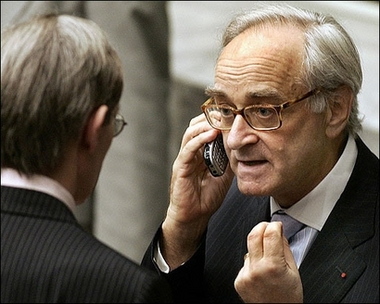
UN Security Council
President French Ambassador Jean-Marc de La Sabliere speaks on the phone
before the start of a Security Council Meeting. UN Secretary General Kofi
Annan demanded an immediate ceasefire between Israel and Hezbollah and
proposed a peace blueprint to end the Lebanon
conflict.[AFP] |
Secretary of State Condoleezza Rice was meeting Thursday night with U.N.
Secretary-General Kofi Annan. Earlier in the day, Annan had denounced both
Israel and Hezbollah and demanded that both sides stop fighting immediately.
"He was talking about a cessation of violence in the context of a lasting,
durable solution, which is exactly what we have been talking about," said State
Department spokesman Sean McCormack.
The Bush administration is playing down expectations for Rice's coming trip
to the Middle East, saying she will not shuttle among capitals to broker a deal.
"You're not going to see a return to the kind of diplomacy, I think, that
we've seen before, where you try to negotiate an end to the violence that leaves
the parties in place and where you have status quo ante," McCormack said.
Administration officials also questioned whether a cease-fire between Israel
and Hezbollah is even feasible.
"We'd love to have a cease-fire," White House spokesman Tony Snow said. "But
Hezbollah has to be part of it. And at this point, there's no indication that
Hezbollah intends to lay down arms."
John Bolton, the U.S. ambassador to the United Nations, said it was time for
the U.N. Security Council to start considering a response, but he, too, ruled
out a cease-fire.
"I think it's a very fundamental question how a terrorist group agrees to a
cease-fire," Bolton said. "How do you hold a terrorist group accountable? Who
runs the terrorist group? Who makes the commitments that the terrorist group
will abide by a cease-fire? What does a terrorist group think a cease-fire is?"
Hezbollah is an Islamic militant group that does not recognize Israel as a
state. It holds effective military and political control over southern Lebanon,
and is the most potent political force on Lebanon's fractured political
landscape.
The Bush administration has repeatedly said that a temporary or quickly
negotiated cease-fire would leave Hezbollah able to regroup and rearm after more
than a week of Israeli missile attacks.
Israel, and Washington as its closest ally, insist that any settlement must
deal with the underlying threat posed to Israel by Hezbollah's control of
southern Lebanon. The Bush administration is trying to hold off international
pressure, while also asking Israel to consider the consequences of its actions
for civilians.
More than 300 people have died in Lebanon, mostly civilians, since Israel
began retaliatory rocket attacks after Hezbollah abducted two Israeli soldiers
last week.
The House of Representatives voted 410-8 on Thursday to support Israel in its
confrontation with Hezbollah guerrillas. The resolution also condemns enemies of
the Jewish state.
House Majority Leader John Boehner cited Israel's "unique relationship" with
the United States as a reason for his colleagues to go on record swiftly
supporting Israel in the latest flare-up of violence in the Middle East.
Little of the political divisiveness in Congress on other national security
issues was evident as lawmakers embraced the Bush administration's position.
So strong was the momentum for the resolution that it was steamrolling
efforts by a small group of House members who argued that Congress's pro-Israel
stance goes too far.
The nonbinding resolution is similar to one the Senate passed Tuesday. It
harshly condemns Israel's enemies and says Syria and Iran should be held
accountable for providing Hezbollah with money and missile technology used to
attack Israel.
House Speaker Dennis Hastert announced he was sending a bipartisan
congressional delegation to Israel this weekend to assess the situation. Hastert
said the delegation, led by Intelligence Committee Chairman Pete Hoekstra, "will
send a clear message that we stand by our ally Israel in the fight against
terrorism."
